BUDDY GUY @ BOWERY BALLROOM

Buddy Guy / Bowery Ballroom / June 1, 2001

After an apprenticeship in Muddy Waters band, authentic blues guitarist Buddy Guy took inspiration from B.B. King and Elmore James to become an extremely talented solo performer with a never-ending body of respected studio recordings. Late ‘60s solo albums such as A Man And The Blues and I Was Walkin’ Through The Woods established his reputation as one of the greatest post-World War II Chicago blues masters. Years hence, Guy continues to release astounding albums that build upon his legendary status.

Dropping the contemporary slickness debasing the otherwise superb Damn Right I Got The Blues for the raw Mississippi backwoods earthiness consuming latent Fat Possum Records’ discoveries R.L. Burnside, T-Model Ford, and the late Junior Kimbrough (whose “Baby Please Don’t Leave Me” and “Done Got Old” Guy rendered convincingly live as well as on record), this sly 65-year old wizard gets back to the vintage sound of his rural Delta upbringing. And ‘01s tradition-minded Sweet Tea is the unadulterated result.

Wearing overalls (his usual attire) and a processed hairdo at this Lower Manhattan hotspot, Guy dug deep into his emotional reservoir, moanin’ and groanin’ ‘bout pain and suffering like it’s nobody’s business. He delved into a host of worrisome songs made richer by a terrific band of experienced bluesmen. It was during the solo break in the soulful mantra, “Tramp” (not the Otis Redding and Carla Thomas’ standard), that Guy did what he loves to do best: walk through the crowd while unleashing some blistering guitar chords that drifted into the foggy air.

Remarkably, Guy always knows how to counter despair-ridden moodiness with humorous, casual asides, teasing the audience while gaining their trust. He also knows how to build intensity by going from fast and loud to slow and soft within the confines of a song. To offset his thick, creamy baritone, he sometimes reached for quivering falsetto notes that handsomely recalled Al Green or Prince in their prime. For the contemplative “Stay All Night,” he balanced hope and desire with anxiety and loneliness like only the best blues men can. His generous two-hour set was so funky you could smell it.

When Guy realized the midnight curfew was closing in, he put together an economical medley of blues standards that included his former mentor’s “Mannish Boy.” Make sure you don’t let Guy slip by. He’s a must see with talent to burn and more energy and verve than performers half his age.

GORKY’S ZYGOTIC MYNCI @ MERCURY LOUNGE

Gorky’s Zygotic Mynci / Mercury Lounge / November 6, 1999

Never hemmed in by conventional ‘90s indie rock boundaries, versatile Welch band Gorky’s Zygotic Mynci was in the Big Apple to promote Spanish Dance Troupe, their breakthrough American release. While fellow compatriots from Wales, the Super Furry Animals, clashed loud, fuzzy, sonic feedback with high voltage rock playing the more spacious Bowery Ballroom a few months back, Gorky’s sound usually drifts through soft acoustical retreats with melancholic folk melodies. They remain a diamond in the rough gigging at the much smaller, more intimate Mercury Lounge.

With brown curly hair that covered his eyes when he leaned into the mike, youthful lead singer Euros Childs manipulated the keyboard while sister Megan glided her down home fiddle into traditional country and Classical folk territory. A brilliant, still maturing songwriter/ arranger, Euros slyly managed to skirt easy comparisons to soft-focus psychedelia, paisley glam-rock, and subtly shaded Velvet Underground sub-pop. Though at times he sang in a carefree, romantic style reminiscent of Bryan Ferry circa Roxy Music’s For The Country or yelped in an anxious, epileptic tone reminiscent of David Byrne’s earliest Talking Heads daze, Euros terse, witty originals gained a hazy dramatic tension all their own.

Early on, Euros’ insouciance pervaded this nights’ most rockin’ tune, “Poodle Rockin’,” a goofy dance party ditty that would have fit in nicely on Talking Heads ‘77. His whimsical mannerisms, witty verses, and sadly romantic understatements were second only to his sharp musical instinct. Though the humble band never engaged the audience with comforting between song remarks, asides, or rambling banter to break up the delicate tension, they handled themselves (and sundry instruments) professionally.

Surprisingly, they never appeared for an encore, even though the crowd clapped in unison and the soundman waited a few minutes before turning on the house lights and cranking up pre-recorded music. Nevertheless, between Euros’ compelling songs and his bands’ austere ability to interpret them well, the work they put into six underrated albums may finally be paying off.

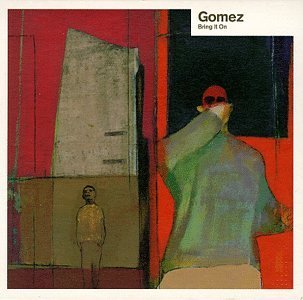
GOMEZ READY TO ‘BRING IT ON’

FOREWORD: Mindful British pop quintet, Gomez, just keep “Getting Better.” After their ’98 debut, Bring It On, won several awards, ‘99s Liquid Skin kept the ball rolling for ‘02s In Our Gun and ‘04s even better Split The Difference. ‘06s How We Operate deserved wider exposure and got some from t.v. programs, Grey’s Anatomy and House. ‘09s A New Tide has been getting good rotation at Fordham University’s WFUV. This article originally appeared in Aquarian Weekly.

1998 winners of Britain’s prestigious Mercury Music Prize for their brilliant debut, Bring It On, Gomez rely on an intimate four-track approach which never limits a profound ability to give each song its own individual complexion. Coinciding with their newfound exposure, the democratic, post-teen quintet found time to record a snippet of the Beatles’ upbeat “Getting Better” for a popular Philips Electronics television commercial.

Gruff-throated tenor Ben Otterwell’s soulful tone and dexterous guitar usually lead the way. But guitarist-keyboardist Ian Ball, guitarist-bassist Paul ‘Blackie’ Blackburn, percussionist Olly Peacock, and bassist-guitarist Tom Gray all contribute compositional ideas, fleshing out intriguing arrangements over the course of time. From the wistful pop wonderment of “Here Comes The Breeze” to the wracked blues-y obtuseness of “Love Is Better Than A Warm Trombone,” Gomez never gets overwhelmed by their diversification. “Bubblegum Years” seems to deride ‘60s/’70s nostalgia with sordid wit: “lost souls/ you and I my dear/ whiskey bottle and a .45.” The totally rad boozy chant, “Get Myself Arrested,” could become a barroom staple with the right promotion. “Whippin’ Piccadilly” gets a lo-fi acoustic treatment reminiscent of Pavement or Sebadoh circa ‘94; and the hushed “Make No Sound” has the same dusky, neo-Classical feel as the Pernice Brothers best tunes.

At Maxwells in Hoboken, besides rendering faves from Bring It On, Gomez blends in some interesting new material that may appear on their next album. Poised and confident, the young combo held the attention of its fans for a solid one-hour set. Beforehand, I spoke to ‘Blackie’ Blackburn.

Was it a struggle to construct such complex arrangements for Bring It On?

BLACKIE: Not really. A lot of the enjoyment was just messing around with the songs. At the same time, we try to get away with certain idiosyncrasies and keep it entertaining. But there weren’t any big problems with the tunes. It’s just a matter of putting parts together.

How do you feel Gomez manages to wondrously merge disparate styles into coherent songs without sounding like antiquated knockoffs?

Good question. You got me. (laughter) I suppose you take an approach to a song and take time to get it down. Like with “Get Yourself Arrested,” we had seven friends in a room strumming guitars and our agent came to the studio and asked someone to sing. We tried to get everyone involved. On the chorus, about eight people sing. That song was actually about a guy who started dealing drugs and took on the whole persona of acting and dressing like a dealer. In the end, he got himself arrested and realized how stupid he was. It’s a play on people who take on false images and then get incorrectly stereotyped.

The only song which truly recalls a specific artist is the cracked swamp blues tune “Love Is Better Than A Warm Trombone.” It definitely borrows its essence from avant-garde bohemian Captain Beefheart.

Its title is a play on “Happiness Is A Warm Gun.” That song got kind of peculiar as we worked it out in the studio.

What new music have you been listening to lately?

Beck’s Mutation is great. It takes his music down to its bare roots. I like Ben Harper’s latest disc as well. He is absolutely amazing.

Give me some background of the coveted Mercury Music Prize Gomez won in ‘98. Did it affect record sales and help get the band recognized?

Sales did go up a bit. The Verve, Pulp, Cornershop, and Asian Dub Foundation have been nominated in the last few years. We’re happy to be nominated for doing something good. I’m not sure how they come up with a winner. They like to promote stuff people haven’t heard of and get underground music out into the open for mainstream audiences.

How will your next full-length disc differ from Bring It On?

We finished the album after Christmas. We had an eight-track and put ideas together for about three weeks. I think essentially our music is an interpretation of what has come before us. We try to take it forward in our own way.

Did you try to capture a larger audience by recording a catchy, mass appeal song like “Getting Better”?

I don’t know. I suppose we have a better understanding of how to approach our music. We’re aware that more people will be hearing it. The working title for the album is God’s Big Spaceship.


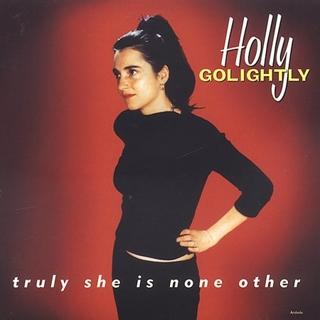
HOLLY GOLIGHTLY PROVES ‘TRULY SHE IS NONE OTHER’

FOREWORD: Relying on old-fashioned rock ‘n soul to strike a chord with subterranean homesick dudes, British singer-songwriter began releasing an album per year since ’95. Her recent three albums fronting the Brokeoffs made no headway in America, but were rightfully critically praised in England. I spoke to the diminutive lass in ’03 to promote multihued delight, Truly She Is None Other.

You’ve got to hand it to Holly Golightly for sticking around just long enough to finally receive decent American exposure. Thanks to her association with underground icon Billy Childish, the indie-minded Brit began Thee Headcoatees (with a few ex-Delmonas) as a female-led alternative to her mentors’ similarly scruffy ‘80s scrap-rock splinter groups Thee Headcoats, the Milkshakes, the Pop Rivets, and Thee Mighty Caesars. Soon, she befriended vintage garage-rock denizen Liam Watson, whose London-based Toe-Rag Studios delivered the finest rough hewn ‘60s-related output. Yet despite moderate success in her homeland, Holly Golightly had failed to garner much US success despite a choice stockpile of respectable ‘90s material.

Luckily, just as the White Stripes were gaining international stardom, they recorded ‘03s critically lauded Elephant at Toe-Rag; bringing in the charmingly adolescent-voiced Holly Golightly for the off-handed coquette ditty, “It’s True That We Love Each Other.” This happy accident gave her kaleidoscopic Truly She Is None Other the forward thrust necessary to attract American listeners. Incidentally, Jack White furnishes sincere liner notes.

Beginning with the echoing controlled exhortation “Walk A Mile,” Holly Golightly’s liberated nasal sneer brings back sexy memories of boot-kickin’ Nancy Sinatra. That is, when she’s not reminding us of ‘60s girl groups the Shangri-La’s and Ronettes on the Kinks go-go confection “Time Will Tell” or the spare dare “You Have Yet To Win” (which seemingly crosses Mickey & Sylvia’s “Love Is Strange” with the Mc Coys’ “Hang On Sloopy”). Interestingly, an unreleased Kinks song, the haunting “Tell Me Now So I Know,” she claims to have picked up from her father, who went to art school with Ray Davies. But the best bet may be her own “This Ship,” a melancholic bass-throbbed lethargy delivered in the manner of “To Sir With Love” singer, Lulu.

Furthermore, since Holly Golightly provided sultry lead vocals to the Greenhornes’ cryptic Dual Mono cut “There Is An End,” she was able to then borrow it as None Others’ twangy spaghetti Western closer and convince guitarist Eric Stein to play on a few numbers. Coming full circle, former Milkshakes drummer Bruce Brand handles drums throughout.

I’ve heard strange rumors via the internet. One claims you were a swinging New York City socialite on the ‘60s folk scene, but you’re too young for that to be true. Another says you got into fisticuffs after drinking Nick Lowe under the table at a British pub in the ‘70s. Lastly, you supposedly told Mick Jones to change the name of pre-punk rockers the 101er’s to the Clash.

HOLLY GOLIGHTLY: (laughing) No. Somebody made that up for lack of proper information. I started with Thee Headcoatees. I hooked up with Billy Childish when he was in the Milkshakes and I’d go see them play. We’ve known each other a long time.

Are there any major musical deviations from your ’96 solo debut, The Good Things, up until now?

I don’t think this album is that different from the first one. I don’t think the songs are that different. I chose the same kind of songs I did years ago. To me, they’re all different from one another, but from the same collection. ‘97s Laugh It All Up! was a covers LP with Ike Turner, Willie Dixon, and the Jaynettes songs. It was mainly Rhythm & Blues, though I did a Kinks cover as well. ‘98s Up The Empire and Live In America (from 2000) were live albums. Serial Girlfriend (’98), for the most part, was actually recorded at home. I took it to Toe-Rag to do overdubs. So they sound slightly different from each other.

After a rush of releases there was a two-year layoff.

I was living in San Francisco for nine months and wasn’t recording. I had a double album singles compilation, Singles Round Up, and a re-issued German release. They filled the gap while I was away.

You seem to pick up a few soul music influences along the way.

Yes, I don’t listen to much white music. Generally I listen to black music like old R & B, soul, and Blues.

Unlike most white female artists – give or take Susan Tedeschi, you interpret black bluesmen rather effectively. I believe Jesse Mae Robinson’s gloomy ‘40s dirge “Black Night” had never been recorded by another woman.

That’s right. I think that’s what makes it charming – what makes it interesting. I don’t buy contemporary music. In my CD player now is a Jimmy Mc Griff disc. He’s a Hammond organ Blues player.

How’d you come up with the medley, “You Have Yet To Win,” which reminds me of early Rolling Stones?

I got the idea for that from an old Little Milton soul track. It’s three songs pasted together, It’s probably the most complicated thing I’ve done in terms of it being original. I like monotony and keeping a song the same all the way through. That’s the exception.

Garage rock icon Sexton Ming joins you on the B-side to the “Walk A Mile” single, “Don’t Fuck Around With Love.” How’d that collaboration come together?

Sexton comes from the same part of the country and is friends with Billy. He was just hanging around and we thought it would be fun to do that as a duet. I’ve known him since I was 15. Sexton played drums with us in Hamburg a month and a half ago.

Have you been receiving better exposure due to the White Stripes track?

Yeah. Certainly. That’s a given. People read my name on their CD and buy my record. But what I do is very different. It’s gotten more people to come out and see us because they’re curious. I can’t think of anybody that’s doing the type of music we’re doing.

What are the former Headcoatees doing now? Getting pregnant?

One of them is. Another is a psychiatric nurse and the other is a potter. We’ve gone our separate ways.

Does it get more difficult to turn out so much material in a short stretch?

I just keep recording as I go on. I’ve got songs in the can ready for the next record. I’ll put them together in the studio when I have free time.

On your slower songs, you croon like a diva.

I think that’s something you have to aspire to. No. I just get up and deliver songs in a business-like manner. There isn’t much of a strategy at all.

Are you inspired by ‘60s pop singers such as Ronnie Spector or Nancy Sinatra?

I hope my music has a little more timeless quality than just emulating the ‘60s. Most of the songs have quite contemporary subject matter. The songs are about different things and go in more directions than that. I don’t want the songs to sound like they were made 35 years ago.

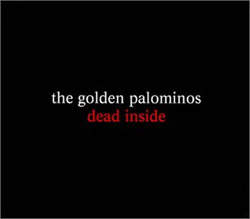
GOLDEN PALOMINOS NEVER FEEL ‘DEAD INSIDE’

Image result for GOLDEN PALOMINOS

FOREWORD: Golden Palominos were a revolving experimental troupe from Manhattan led by Cleveland-bred composer-percussionist Anton Fier and permanent fixtures Nicky Skopelitis (guitar) and Bill Laswell (bass). I met Fier in ’96 to promote Golden Palominos final album, Dead Inside, a one-time collaboration with feminist-poet Nicole Blackman. He has maintained a low profile since. His first and only solo disc, Dreamspeed, dropped in ’94.

As for the lovely Blackman, I befriended this adorably sarcastic vixen ‘round Dead Inside’s release, giving plaudits to her spoken word performances and Golden Palominos venture. I took my family to see her rather satirically squalid poetry reading during a tiny music fest at Tompkins Square Park. A decade forward, I caught up to her at a Girls Against Boys reunion show at Mercury Lounge. She was dressed to the nines. It seems she was right about her Karma Boomerang Theory (read below). Blackman, by this time, had gotten enough publicity from Dead Inside to audition for and become one of the most popular t.v. voiceover sales pitchmen, promoting Chrysler, Ford, Blockbuster, and Verizon (not that the Nicole Blackman I know really gives a fuck about these viper-like corporate dinosaurs). This article originally appeared in Aquarian Weekly.

Anton Fier’s highly experimental Golden Palominos have successfully fused jazz, rhythm & blues, and rock elements into modern electronic music since 1983. A brief chronological history shows Fier collaborating with no wave guitar master Arto Lindsay, free form reedist John Zorn, funk bassist Jamaaladeen Tacuma, conceptual sound designer Bill Laswell, rock pioneer Fred Frith, and instinctive jazz/ rock visionary Nicky Skopelitis on the Golden Palominos sparkling ’83 debut. ‘85s Visions Of Excess and ‘86s Blast Of Silence followed, incorporating rock luminaries Michael Stipe, John Lydon, Richard Thompson, Jack Bruce, Syd Straw, and T-Bone Burnett. ‘89s ambient changeup, A Dead Horse took Bernie Worrell and Mick Taylor to task with Skopelitis and Laswell. ‘91s Drunk With Passion surrounded Stipe and Thompson with Bob Mould while both ‘93s This Is How It Feels and ‘94s Pure brought onboard exquisite vocalist Lori Carson.

But while Carson’s lyrical imagery and soft as a kitten voice sprinkled Fier’s dreamscapes with gold dust, spoken word ingenue Nicole Blackman helps Fier throw caution to the wind on the Golden Palominos eighth release, Dead Inside. By slinging mud at downsized American dreams and the victims left in its wake, Blackman recounts depressing obsessions and disturbing dilemmas with scatological intensity and unparalleled wit. Along with guitarist Knox Chandler and bassist Bill Laswell, Dead Inside may be the most ambitious step forward yet for Fier’s revolving unit.

“I see music as a religious cleansing,” asserts Fier. “With this record, I consciously changed directions out of the need to do it both musically and personally. I came to this point subtly. When my life starts to feel stale and I want to distance myself from what I’ve previously done, there’s a reaction involved. And at this juncture I wanted to make as pure a record as I could make. All my other collaborations seemed to be a compromise – which was only natural. I approached this record as if it was the last record I’d ever make. There was little compromise and it was less cliched.”

He ascertains, “Music is the language I feel most comfortable with when I’m exploring my own personality and problems. Music allows me to get in touch spiritually. Instead of going to church and praying, I do it by redefining my music.”

But lest any music critic term his music ambient, ‘illbient,’ or transient, Fier seems both apprehensive and fascinated with others labeling his music.

“DJ Spooky is representative of the illbient scene. My music is quite different. It’s inspired by Eno’s Music For Airports and Discreet Music. And before that, by people in the ‘30’s who experimented with drone. Terms like illbient are created to help sell something. If I had one hope, it would be to one day create music indigenous of itself. I’m just out here living a life as best I can. I’m a one-dimensional person. At 3, I became aware of music. And by 10 or 11 years old, I thought I wanted to be a musician. But the art of playing music is different than the art of making records. In recording studios, I learned how records were made. And I’ve been blessed with the people around me, both personally and musically. They made my childhood dream a reality. I’m not about to judge other musicians’ motives or intentions. To me, it’s how I deal with the world in an uncompromising fashion.”

When asked which records inspired him as a youngster, Fier admits, “As a kid, I responded to novelty records, then, the Beatles and Stones and psychedelic music. If I had to name a record that was a true influence, I’d say On The Corner by Miles Davis. It came out in ‘74 after Jack Johnson and Miles At Fillmore. When I first heard it, I found it to be a step in a transcending direction. It’s not rock or jazz. It was an electronic fusion with tabla and it was rhythm oriented. I still listen to it once a week. And it got negative reviews when released. But I once saw a great quote which stated, ‘all criticism is transient, only the work itself remains constant.’ And with my works, I try to respond instinctively to the process of recording. If it feels right, go with it.”

It was during the summer of ’95 when Fier hooked up with Nicole Blackman, a busy New York artist-publicist whose piercing diatribes and psychosexual analogies confront despair, self-doubt and hopelessness with pinpoint accuracy. After reluctantly appearing on KMFDM’s Xtort LP, and the subsequent tour, which brought her anguished nightmares to an international audience, Blackman was chosen over a few potential candidates to write lyrics for Dead Inside. Her liberating and disturbing images set the thematic flow of the disc in motion.

“With Nicole, I felt able to explore uncharted territory. She allowed me to have tremendous freedom. She didn’t bring a traditional songwriting sense to the project,” Fier says.

Blackman maintains, “At no time during the compositions did Anton say ‘ooh, that’s spooky’ or ‘what’s going on.’ Others would feel trepidation or nervousness about the emotional violence in my pieces. But it was incredibly thrilling and terrifying to be under such pressure writing for a score. I never knew when we would hit a breaking point. If we do another collaboration, I don’t know if we could get any darker. It may not be appropriate. Anton thinks maybe we should go in the opposite direction. Basically, every character on the record is in some form of transition, whether it’s to change their life or prepare for death. Maybe the next record will deal with people who’ve already made their decisions and people who have no more options.”

Blackman’s aggressive poetry has been compared favorably to a few male angst writers, but nary a female writer. She’s neither a traditional poet nor a typical spoken word performer. And sometimes her character pieces detail accounts she experienced firsthand. She ease drops on conversations and picks up tidbits of information, playing Harriet the Spy gathering evidence against unsuspected people.

“It’s very easy for me to separate myself from my works, “Blackman insists. “I hear Dead Inside as a snuff film watched with eyes closed. It’s very cinematic. Like a film score composer, I try to fit the mood of the basic rhythm track. I’d listen to 10-minute tape loops with my headphones on in the dark and link my lyrics to music. “Thirst,” in essence, is a love song. But its words were originally put to ‘Drown.” Then Anton decided to put the Lawrence Of Arabia epic sounds in there. It’s like a caravan with camels and billowy things.”

While Blackman claims money is not an immediate consideration, she believes in the Karma Boomerang Theory. “If you throw enough good energy around and help people for free, somehow it will come back to you and fall into your lap.”

GOGOL BORDELLO CELEBRATE THE NEW REVOLUTION

Being able to dull the thin line separating elementary Anglo rock mannerisms from plausible ethnocentric eccentricities is a tricky proposition deviously aggrieved by cries of cynical corporate sellout or wretchedly foul thoughts regarding homogenized fraudulence. Obsessively accepting multi-cultural plurality while keeping solid footing in established rock tenets could be destructive or detrimental for anyone deigning fame with less-than-visionary intentions. Only indisputable revolutionaries need apply to formulate such an alien admixture since any ostensibly illegitimate act on their part will be seen as treason and those involved shall be torturously libeled.

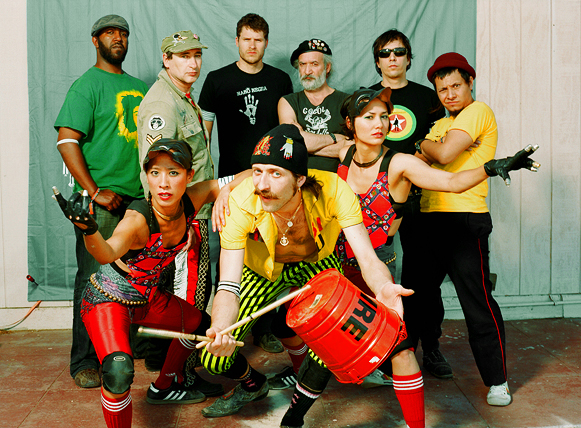
Nevertheless, remarkably zany handlebar-moustached warrior, Eugene Hutz, daringly combines caliginous Eastern European tango and perky Bertolt Brechtian cabaret swing with pre-punk demigod Iggy Pop’s nihilistic gallivanting rumble and the thuggish ruffian subversion scruffy Irish rogue Shane MacGowan lent the Pogues. Hutz’s rough-and-tumble outfit, Gogol Bordello, adventurously ubiquitous globetrotters whose completely shambolic and imminently maniacal live shows have broadened their appreciative audience, help the salty busker ‘chaotically clash’ abrasive streetwise punk, lurid Vaudevillian trash, inebriated polka, and slunk salsa into frenetic pan-ethnic exuberance.

Ringleader Hutz provides pixilated Balto-Slavik-derived Indo-Euro linguistics and mischievously opulent debauchery to strike up his band of gypsies’ spontaneously ratcheted-up crackle with marvelously distinctive, wholly fantastical authenticity.

Born outside Kiev near the Ukraine’s Carpathian Mountain region during 1972, Hutz became a political refugee after the ’86 Chernobyl nuclear disaster and tyrannical Soviet turmoil forced his family to seek asylum in Poland, Hungary, Austria, Italy, then America. Hutz’s father played in one of the country’s first late ‘60s rock groups, Meridian, while his mother was a gypsy tap dancer-singer. Thereafter, their talented teenaged son began collecting black market tapes featuring experimental post-rock harbingers Einsterzende Neubauten, Birthday Party, Suicide, and the Contortions, bouncing around in formative psychobilly, industrial, and metal troupes before finding his true muse.

By ’98, Hutz was performing Russian weddings in bucolic New England haven, Vermont (where he landed stateside in ’92). Moving to New York City within a year, he embraced the world’s cultural capital with not only skillfully claustrophobic compositional pandemonium, but also an expansive gypsy punk revolt and colloquial Dadaist mentality designed to discourage rhetorically generic faux-punk posers crowding the currently compromised local underground scene.

Taking its primary moniker from grotesquely melancholy, profoundly visionary 19th century Ukrainian anarchist, Nikolai Gogol, Hutz’s wily assemblage espoused a colossal cast of immensely diversified instrumentalists. Madcap violinist Sergey Rjabtzev and picaroon accordionist Yuri Lemeshev, both ex-pat Russians, enjoined D.C.-based Ethiopian bassist Tommy Gobena, Israeli spaghetti Western-informed guitarist Oren Kaplan, and female dancing percussionists, Pam Racine and Elizabeth Sun. Furthermore, febrile drummer, Eliot Ferguson, was brought onboard to add a mandatory rock frenzy.

An enduring cathartic barrage of consistently engaging material compactly transporting and transposing Hutz’s hyper-sardonic wit bolsters ‘99s Voi-La Intruder and ‘02s Multi Kontra Culti Vs. Irony, early Gogol Bordello albums scouring a sacred, if nefarious, heritage soon-to-be reverberating halfway ‘round the universe. By trusting steadfast instincts, this cosmic harlequin toppled any tangibly bona fide ‘Sirva Roma’ tribal lineage with a liberating punk ethic, propelling a never-ending international block party. Acutely aware of the common principle uniting borrowed traditions they convolutedly revere the glorious past while rebelliously jettisoning Old World methodology. Standing on the precipice of achieving top echelon touring status, Hutz’s hedonistic crew is on a mission to convert puritan squares and indie snobs alike.

On ‘05s frightfully clever Gypsy Punks, Hutz’s emphatic baritone rasp leads the assault. There’s no denying the penetrable impunity of his ruggedly coarse voice, a grainy instrument employed for garrulously celebratory toasting and perfectly suited to shakedown musty broken-down post-Depression gin mills. Campy opening jig, “Sally,” may sound ‘Balkanized,’ but hits closer to home with its nominal Nebraska lass unwittingly spreading Hutz’s uplifting mutiny all over the state’s heartland. A siren awakens incriminating Balkan reel, “Not A Crime,” a damning mandate condemning fascist modern day oppression. Another veritable shotgun blast, “60 Revolutions (Per Minute),” pile-drives Kaplan’s metal guitar shrapnel through Hutz’s crassly emblazoned righteous screed dismissing faddish pop scum: ‘I make a better rock revolution alone with my dick.’

Following the dressed-up Lower East Side flamenco flange, “Avenue B,” snazzy beat-driven wedding day jolt, “Dogs Were Barking,” rips it up cryptic tango fashion. And provincial party anthem, “Think Locally, Fuck Globally,” comes off like a growling homeland shrug-off counter-intuitively lauding the Big Apple’s still-thriving bohemian temperament. Elsewhere, dub-styled breakdowns, alien reggae transmissions, and minimalist no wave schemes detonate inside multifarious numbers.

Undoubtedly though, the best way to experience these frantic neo-pirates is in concert, where they knock ‘em dead every time. A dangerous elixir of Klezmer, Indian rai, and Middle Eastern elements, increasingly noticeable on record, send shock-waves traipsing a headily combustible din of ecstasy and find sanctuary inside Gogol Bordello’s freakishly bizarre symphonic wizardry.

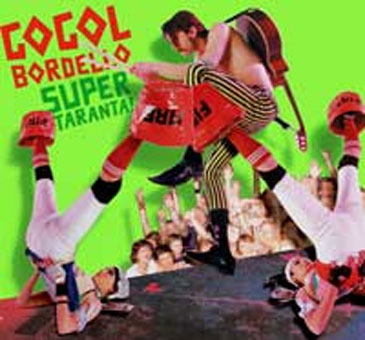
But while Gypsy Punks petered out a little towards the last few nebulous tracks, ‘07s mighty Super Taranta! (SideOneDummy), recorded live in the studio with minimal overdubs, continually cuts like a jagged knife. Sharper violin snipes, starker accordion swipes, and bolder cymbal-skin strikes create a terrifically riotous volcanic eruption upon impact, refusing to relent from beginning to end.

“When we make a record, we’re not baking a cake with recipe in hand. A lot of what goes on is unconscious and maybe a stop at some gas station in Morocco a year ago had more to do with the sound than all the contemplative work,” Hutz says.

Overall, there’s a primary redemption theme that transverses the boastful secondary motif of conquering badly contrived popular minstrels with finer tuneful cuisine. For instance, “Harem In Tuscany” and the spherical title track are direct descendants of Italy’s bastardized musical exorcism, tarentella, a curative mystical ritual transforming negative energy into positive sought here as a therapeutic phenomenon aiding rapscallions nauseous with modern media-manipulated hysteria.

Concerning “Harem In Tuscany,” Hutz says, “If we read into the lyrics, it seems like the turmoil of some nonsensical journey, where a rebel forgets his cause and everything else, loses his perspective, and returns to the bottom of the bottom to regain it. Profound or not, it’s a simple reminder of the inability to accomplish something and hold on to it. It’s impossible. It requires constant reinvention. That’s the life.” He then concedes, “It also reminds me of other good things like the fact politicians could only be wrong!”

More conventional listeners will initially be smitten by well-received upheaval, “Ultimate,” a pungent flamenco-throbbed treatise spitefully alleging ‘there was never any good old days/ they are today/ they are tomorrow.’ Its easy-to-grasp revelry begs for contemporary airplay.

“It wasn’t written for the mainstream audience,” he admits. “But, if it reaches them, perhaps that’s reason for optimism. If more people are ready to re-tune into a pro-positive attitude and the high frequencies proposed in that song, the better for all of us. As far as commercialism goes, I have no idea how it reflects on us. We’ve come a long way on our own terms. Nobody tells us what to do and we’re going strong. Go figure. It’s fucked up. On one hand, we’ve always been going against the grain. On the other, we’re living proof of the American Dream.”

While “Ultimate” discontentedly abjures the arduous past and “Zina-Marina” prophesizes a downcast future, the question becomes where’ve all the good times gone?

Hutz claims, “Though the song “Ultimate” is about hidden positive meanings of life, “Zina-Marina” is a topical song – a guerrilla journalism story about Eastern Europe’s dark side, which is spreading rapidly west-wise. Obviously, there’s awareness about both sides of life. But as an engine, I choose to be optimistic. Not because I’m a fool. No. I’ve been jaded before. That’s exactly where I learned cynicism and pessimism are actually dead ends for the spirit. I respect spirit too much to suffocate it with pessimism.”

Let’s not overlook how Hutz and his fellow Ukrainians deal with serious sociopolitical problems in charmingly satirical fashion. Sarcastic humor has certainly gotten ex-Soviet proletariats through various uncompromising Third World predicaments (lack of funds, household goods, and raw material).

“That’s our survivalist way,” he declares. “Perhaps the words ‘Wild East’ already properly replace ‘ex-Iron Curtain region’ at this point. That, itself, reflects the situation a lot. Of course, as a native I have romantic sides I’m endlessly drawn to. But there’s just no way to get anything done there. I mean ‘anything,’ and I mean ‘done.’

Analogously, “Tribal Connection” gripes about a conservative village infringing on people’s rights, possibly a microcosm of America’s post-911 raid on individual freedoms and liberty.

Hutz adds, “The funny part about it all is that whatever political criticism occurs in our songs people automatically think it’s about the United States. But have you ever been to Sweden? As far as regulations go it is America times 100! This crudity is a worldwide tendency. It needs challenges from people with positive power from artists and generators of good energy. The good news is we’re everywhere, too!”

Getting further into the midst of Super Taranta, “Suddenly (I Miss Carpathy)” mutates into some kind of weirdly swinging Yiddish hat dance. The dazzling fast-fiddled dub-plated jubilation, “Forces Of Victory,” heaps speed metal axing atop slapdash drumming. And the festive “American Wedding,” augmented by the horn-drenched Slavic Soul Party and descending violin stabs, snubs quick-fix 24-hour North American connubiality, fancying instead, the three-day matrimonial galas his distant birthplace afforded.

Despite its dagger-like reggae-tinged seafaring ‘ho-ho-ho’ drunken chant, the conciliatory “Supertheory Of Supereverything” kicks dust in the face of misguided autocracy and pledges a ‘super-conducting’ alliance. Distrusting biblical disciples and agitated despots while relishing a heterogeneous united front, this purported coalition of party people rants, ‘Yes! Give me Everything Theory without Nazi uniformity/ my brothers are protons/ my sisters are neurons/ stir it twice it’s instant family.’ In summary, Gogol Bordello are allied phantoms conceiving a dungy all-inclusive circus atmosphere (usually not out of step for fandango dancing), with Hutz playing the leading role as askew carnival barker.

On another adjacent tip, Hutz has appeared onscreen in a commendable supportive role, landing the part of Alex for filmmaker Liev Schreiber’s Everything Is Illuminated, alongside award-winning actor Elijah Wood. The story line involves a post-adolescent Jewish American traveling from Odessa to Ukraine questing for a woman who had saved the grandfather of Wood’s character, Jonathan, from Nazi invasion.

The jaunty Hutz exclaims, “Liev must’ve been temporarily insane! But it all seemed to work out at the end. It was my music that brought me into it. He was interested in Gogol Bordello as soundtrack writers. But I just said, ‘yo man, give me the lead and I’ll fix it up for you real nice.’ He made a few phone calls and I was on my way to Hollywood. So in retrospect, we have a lot of laughs and stayed good friends…with more or less regular drinking assaults on the neighborhood”

Though Super Taranta!’s liquored-up dirge, “Alcohol,” could have served as an incisive drunkard’s tribute or hangover medication for the two sauced buddies, Hutz denies these assertions.

“I just wanted to write an ode to alcohol – something that shows real beauty of this substance and how important its presence is in our culture. But to write about that, you must really qualify. Otherwise, it’s just a banal topic. So I couldn’t go near it in my twenties, despite massive consumption. I felt like I still didn’t have the mileage required. But now, in my thirties, I felt qualified. It just rolled off the tongue and the music came in a second.”

During, albeit, limited downtime, Hutz archived a homespun tale of real life terror. The recent documentary entitled Pied Piper of Hutzovina dealt with fleeing Ukraine after the unfortunate Chernobyl mishap. Hutz promises it’s a strange film too personal for some and too devastating for others. But those who fetishize gypsy culture will find a natural Romany habitat sans typical soused stereotypes. Instructively, director Pavla Fleischer shared many heroic moments with Hutz in Ukraine, Hungary, Russia, and Syberia.

So the prospective artistic endeavors for Hutz seem almost infinite. Let’s hope he doesn’t sacrifice Gogol Bordello’s unrivaled musicality for cinematic celebrity.

“I’m thinking of inventing a new style of musical activity that can uncork the masses and become a form of not only physical expression, but also mental and spirit-wise. Like the Ukrainian mountain folklore of Kolomijkas – which is based on poking fun at one another with rhymes over infectious beats and manic tempos,” he insists. “That’s the premise of Mititika, a new electronic project I’m making with a Romanian singer and dancer. If I could transcend that feeling into a worldwide context with my fucked up synthesizers, it’ll be massively successful.”
GLENN MERCER GETS ‘WHEELS IN MOTION’

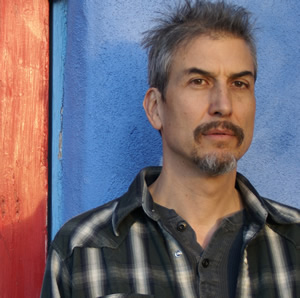
The Garden State has its fair share of admirable bands that’ve passed into history without proper recognition, left behind by conservative mainstream forces whilst arbitrarily getting lumped into college radio’s vast expanse. Enigmatic cult legends, The Feelies, like neighboring Manhattan antecedents, the Velvet Underground, influenced dozens of promising independent bands. Having an impact way beyond the few thousand copies winsome 1980 entrée Crazy Rhythms sold, these unsuspecting harbingers presaged ‘90s DIY bedroom pop a la Sebadoh, Liz Phair, and Jack Logan. Initially, singer-guitarists Glenn Mercer and Bill Million fronted the trailblazing combo with bassist Keith Clayton and iconic Cleveland native, drummer Anton Fier (Golden Paliminos) in tow.

“Prior to the Feelies, Dave (Weckerman: percussion) and I were in (developmental precursors) Outkids. Bill joined on bass, the band broke up, then we auditioned singers,” Mercer recollects. “One was an Iggy clone obligated to demonstrate his stage persona, rolling around the floor while we jammed in audition. So I became singer by default.”

Though signed to archetypal punk label, Stiff Records, during its halcyon daze, the Feelies had a soothing beauty lost on rebellious punks. Too unhip, well adjusted, and low key for voguish punk acceptance, the Feelies weren’t as exciting live or inventively eccentric as friendly CBGB rivals Television and Talking Heads. They may’ve had a naïve, understated tone, but always provided stimulating six-string lattice and temperately variegated percussive elements (tom toms/ timpani/ claves/ snares/ cowbells) to push forward prudently rudimentary compositions.

Long-time Haledon resident Mercer affirms, “I was never a fan of large scale production. Lo-fi superceded the polished material. I never got into arty bands. They lost the essence of what rock and roll was.”

Inadvertently, the Feelies prefigured many ‘80s indie rock ideas on the timeless Crazy Rhythms. The huskily half-sung baritone timbre draping carefree “Original Love” foreshadowed Morrissey and spurred Violent Femmes’ nervously conversational assimilation “Blister In The Sun” while lengthy lexical epithet “The Boy With Perpetual Nervousness” imbued Belle & Sebastian’s similar tonicity and drawn-out titular descriptiveness. The cautiously sustained tension of “Forces At Work” unwittingly informed slo-core progenitors Slint and still-vital Hoboken magnates Yo La Tengo.

Of the latter, Mercer says, “We became friends. (Leader) Ira (Kaplan) did an early Feelies interview. I played with them a few times, did the Maxwells’ Hanukkah shows, and may’ve done a Psychedelic Furs song with them. Ira got us into (paisley pop purveyors) Dream Syndicate, (de-constructive subversives) the Minutemen, and (post-punk mavericks) Husker Du. Apparently, Steve Wynn started the Dream Syndicate after seeing us at Whiskey Au Go-Go. They, in turn, influenced us.”

Perhaps even more profound, the garbled verbal mumble of “The High Road” found its way into college rock lynchpins R.E.M.’s precociously analogous utterances.

“Peter Buck (who’d co-produce The Good Earth) acknowledged our influence. In turn, they took us on a large-scale tour,” Mercer says. “We got good responses in places we’d played before: Boston, New York, Philadelphia. Bands like the Meat Puppets and Rain Parade claim Crazy Rhythms was influential.”

Inversely, Mercer’s subtle, effective, fey eloquence and easygoing manner knowingly beckon folk-bent nerd Jonathan Richman’s anthemic “Roadrunner” on Good Earth’s distended title track. And the quickly jangled beat-driven skitter of Beatles re-make “Everybody’s Got Something To Hide” reinforces Mercer’s Beatles fascination.

“My mom played some keyboards and always had the radio on,” he recalls. “She brought me the first Beatles record. My favorite early Beatles songs were inspired by Chuck Berry. I wasn’t aware of him, Bo Diddley or Buddy Holly prior to that. Right now, we do “You Can’t Do That” live ‘cause it has a cowbell part. People love that.”

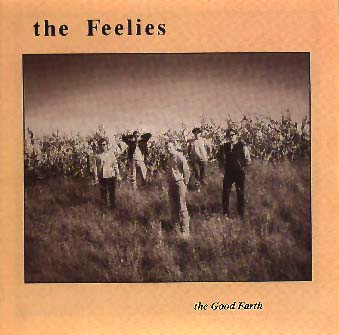
Following a six year pause (when he drummed for subdued Eno-induced tranquilizers, the Trypes, ‘til his sister returned from college and took back her kit), belated ’86 sophomore set, The Good Earth, found Mercer and Million no longer one step ahead of the curve. The Feelies break no new ground and at this juncture look to proteges REM for inspiration, but the new-sprung songs are more uniformly lustrous, eloquently formal, and personal, even if they can’t invent mod vistas for green basement bands anymore. It’s as if they woke up and it was suddenly “Tomorrow, Today.” Yet the band’s completely focused, mature, and confident, as fresh acquisitions, bassist Brenda Sauter and drummer Stan Demeski (Luna), assist.

The difference might seem negligible, but they lean towards folk-pop instead of soft rock when drifting into the ozone. South of the Border rhythms and then-fashionable cow-punk riffs lend tertiary supplements. An increasingly noticeable plainspoken balm, comparable to Velvet Underground’s narcotic impulse, permeates pitter-pattered spangle “Last Roundup” and hastened jam “Slipping (Into Something).” Peculiarly, a recessive dramatic stillness first introduced on the debut’s angular “Moscow Nights” eerily inaugurates the wistful “Slipping.”

“It’s not silence. “Moscow Nights” (utilized) a foghorn, a boat in the distance, and wind,” Mercer instructs. “It’s like modern avant-garde composer, John Cage, who’d set the mood with buried sound affects to make you aware.  There was talk about remixing The Good Earth, to bring up the vocals, but that’d ruin the record’s charm.”

Lean acoustic strumming guides ‘88s It’s Only Life, where a reacquired innocence emerges. Now signed to major label, A & M, a more capricious, less serious tone conveys brightened whimsicality to resplendent contemplation “Too Much,” endlessly looped guitar-grooved “For Awhile,” and a sentimental cover of Velvet Underground’s “What Goes On.”

“It was easy mastering Velvets songs when I learned guitar. Their stuff was easy to play. I gravitated towards that, the Stooges, and Rolling Stones. I was big on jamming, like the Velvets and Stooges let loose improvising, but not as far as the Grateful Dead went.” He adds, “We got to do a Lou Reed tour of smaller theatres. He came up to play with us at a Philly radio station and then onstage. He didn’t want to sing. We did a medley with him just playing guitar. He reluctantly inched forward and took over the mike and convinced us to go back and do “Sweet Jane” very impromptu.”

Moreover, It’s Only Life’s inarguable standout, the contagiously labyrinthine resonator “Away,” proved to be a high water mark, soothingly advancing to a glistening radiance as Mercer’s nonchalant inflexions airily float inside its recurrently somniferous intoxication.

Mercer reminisces, “Jonathan Demme directed “Away’s” video. I had worked with him on the movie, Something Wild. We felt comfortable he’d do a good job. He contacted us with an idea about filming a concept. We were gonna call it “Night Of The Living Feelies,” where zombies file into our show and by the end, they’re all rejuvenated. But it never came about. Instead, we did it at Maxwell’s.”

The Feelies second A & M album, Time For A Witness, came out at a bad time, when the label got purchased by Universal. Made at New York’s huge Power Station in ’88, its glossy polish and sophisticated expressiveness caught critics’ ears, not fans.

Mercer reflects, “A & M didn’t drop us, but wouldn’t offer tour support. It’s hard to get to the next level. We had more people in the road crew than the band. We toured with Mike Watt’s Firehose. He had a word, jam-econo, doing tours on a budget.”

Million quit, moved to Florida, became a Disney World locksmith, and temporarily lost touch with Mercer, who’d go on to record with Weckerman in Wake Ooloo, a loud, aggressive duo predating the White Stripes that criss-crossed Weckerman’s side band, Yung Fu. Then came a ten-year break.

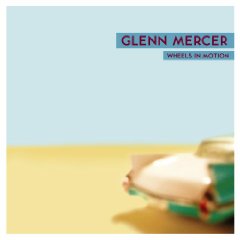
But time marches on and Mercer’s first solo effort, Wheels In Motion, brings forth a batch of guilelessly prospective tunes.

“I went through its lyrics and noticed I’d said the word ‘time’ an awful lot. You tend to look back when you have kids,” Mercer concedes. “Like The Good Earth, it’s acoustic, low key. Maybe that’s because I have bad tinnitus, ringing in the ears, from playing on stage, checking amps, and cranking volume in-studio to simulate live sound.”

Captured in his home studio, Wheels In Motion perpetually relies upon articulate guitar prowess and an underlying emotional shrewdness to guardrail its peppier moments. Faithful Feelies comrades’ Weckerman, Demeski, Fier, Sauter, and Vinny DeNunzio dress up a few cuts each. Buoyant wonderment “Whatever Happened” closely resembles the early Feelies precipitated hasten with its masqueraded passive-aggressive urgency. An unwaveringly upbeat swagger belies resigned tambourine-shaking jingle “Get It Back.”

But pensive lullabys, “Days To Come” and “Morning Lights,” possess a defiantly chimed circumspection matching the discreetly foreboding Casio organ undertone swamping “Here And Gone” and “Another Last Time.” Experiencing life within rock’s narrow margins, the resurgent Mercer needn’t manufacture the wintry discontent and disillusionment steadfastly pervading Wheels In Motion’s darker side, even if the 50-year-old seems entirely secure transmitting George Harrison’s pacifying psychedelic Indian mantra, “Within You, Without You.”

On a grander level, will Mercer ever receive deserved aboveground plaudits? Or will he carve out a factional niche the same way fellow Northern Jersey band the Wrens have done releasing similarly sporadic material. Either way, he’ll retain the dignity and respect much bigger artists sometimes begrudgingly get.

HOWE GELB PULLS DOUBLE DUTY

FOREWORD: Spontaneous lo-fi bohemian, Howe Gelb, is happy living in partial obscurity as a virtuous cult artist. But unlike prolific Texas folk-blues renegade, Jandek, a weirdly anti-social commoner, he’s available for comments and glad to see you. But just when you think you’ve caught up to his catalogue, the damn guy releases something else. There’s about a dozen recordings as loose collective, Giant Sand, a few as Band Of Black Ranchette, and a growing number as a solo artist. ‘06s ‘Sno Angel Like You may be his finest solo work. This interview was conducted to coincide with Gelb’s concurrent solo LP, The Listener, and Band Of Black Ranchette’s Still Lookin’ Good To Me. Gelb had me sent my 4,000 beer and ale reviews online a few weeks after we spoke in ’03. But he admitted he’d rather hear about my exciting cross-country travels than read the reviews – a problem I’ve struggled with to this day. This article originally appeared in Aquarian Weekly.


“Denmark is a lot like ‘50s America. Its slow pace, lack of traffic, excellent daily baked bread, fresh beer, a quality and quantity of musicians that are great to hang with, and about the best rain I’ve ever been soaked in,” full-blooded American underground rock icon, Howe Gelb, offers. He has called me from the European home he shares with wife, Sofie, and one-year-old daughter.

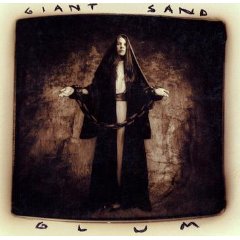
Pennsylvania-bred Gelb began recording rough-hewn guitar-strewn sketches independently as Giant Sandworm way back in ’79 – over a decade before Liz Phair and Lou Barlow made lo-fi indie rock acceptable. Along with founding guitarist Rainer Ptacek and a revolving lineup, Gelb recast Giant Sand in the Tucson, Arizona, desert during the ‘80s, delivering minor classics such as ‘88s contagious Storm and ‘89s spontaneous Long Stem Rant.

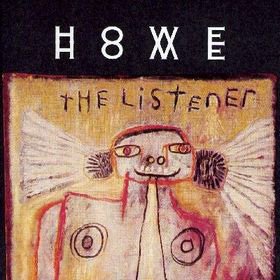
Not far removed from the spiritual revelation of Nick Cave’s prodigious ’01 recording, No More Shall We Part, Gelb’s poignant ’03 solo disc, The Listener, addresses his own mortality and profound musical re-awakening with sophisticated grandeur. Perhaps spawn from the solemn dirge, “(well) Dusted (for the millennium),” from ‘00s Giant Sand release, Chore Of Enchantment, where Gelb coyly suggested ‘Jesus might return, if only a slight return,’ this wayward beatnik drifter canonizes lost comrades (ex-Giant Sand partner Rainer, aged-in-wool country pal Pappy Allen, and a stepsister). He also seeks eternal wisdom on the disjointed medley, “B4U (Do Do Do),” which appropriately slips into Bill Withers’ comforting Gospel-inspired redemption, “Lean On Me.”

Inspired by be-bop pioneers and re-invigorated by eloquent Jazz-skewed Denmark band Under Byen (Howe’s newest cohorts since Giant Sand partners John Convertino and Joey Burns remain busy with fine collective, Calexico), Gelb allows guest vocalists more space to maneuver on The Listener. Popular Danish singer Marie Frank coos like Cat Power on the creamily-oozed “Blood Orange”; Brett and Rennie from neo-trad Country duo Handsome Family caress the tender piano trinket “Moons Of Impulse”; and Under Byen’s Henriette Sennenvaldt intimates Bjork’s desperate fragility on the witchy salsa “Torque.”

On the deviously apologetic blues retreat, “Felonious,” Gelb’s piano steals ‘Lou Reed licks, licks he probably stole,’ as he speak-sings in a monotone voice wholly reminiscent of the ex-Velvet Underground legend who’s then revisited on the relaxed acoustic respite, “Lying There.”

Concurrently, Gelb’s loose-knit side project, Band Of Blacky Ranchette, has spit out the threadbare Country-smitten backwoods charmer, Still Looking Good To Me. Its dusty rural serenades and half-baked train songs provide random escapism.

On top of that, Gelb’s growing list of solo projects include ’91s Dreaded Brown Recluse, ‘98s Hisser, ‘00s Down Home, and ‘01s Confluence.

Since Chore of Enchantment, you’ve constructed full-blown arrangements more often.

HOWE GELB: That’s an accident of age. Rainer was my best buddy, but he died of brain cancer a few years back. We started Giant Sand(worm) around ’79. I’d also done Band Of Blacky Ranchette. Anyway, when he got sick, he started doing things that were leaner. Instead of being Neanderthals, everything meant more because he saw the mortality factor kick in and it only allowed him to do certain things. So my music got tighter just from spending that time with him. So maybe that gave the illusion of arrangements. Chore came out after his death, as did the new Blacky Ranchette.

The new Blacky Ranchette songs seem off-the-cuff compared to the orderly The Listener.

I like music minimal. That’s just its nature.

How do you know which songs fit solo endeavors as opposed to group projects?

The songs let me know. I have piles of songs. My best investment was to buy a Sears Craftsman box on wheels that locks. I throw all my recordings in there on DAT tape or CD that I make throughout the year. I’ll go through the stuff and do some house cleaning. Then, I compile these different records. Blacky is more influenced by old Country. It’s my take.

How does earlier Blacky Ranchette material compare to the new set?

The first one was more rambunctious and vocals more energetic but worse. You can hear fun guitar interplay between Rainer and me. There were endless jams we used to do. The next one maintained a more upbeat barroom tone. The third was mellower and this one is more so except two songs with Neko Case that she rode shotgun on and ended up mixing herself. Then, there’s the one I did with Grandaddy that’s “Working on the Railroad.” The rest is more Texas troubadour stuff where there’s a long meandering story with wacky small weird bits. I stay away from the dismal, dark, dank weight of Chore. It’s too depressing to listen to that.

Chore’s lyrics seemed more detailed than past recordings.

That record took over a year to finish. I started recording seven weeks after Rainer’s death and couldn’t hear straight. When we started working with Jon Parish (PJ Harvey) on that, I was unintentionally giving him a hard time. I thought the material was too old and I sucked on some. My voice was too weird. We divided the material into two camps. The Rock Opera Years was a tour-website only CD of unreleased Chore material. Many people prefer that one. It was tumultuous in the sense that Rainer had spent an extra 20 months here after being diagnosed with cancer. He was doing well until the final seizure when I was wrapped up with his family. So maybe more heart and soul was put into Chore because I was able to re-think ideas.

‘94s Glum was another disconcerting album since C & W pal Pappy Allen died in its wake.

Yeah, but my stepsister had died. When I wrote “Left,” it sounds like Pappy, but I wrote it for her. Before the record came out, Pappy passed away. I remember I was singing like crap but loved the songs and the way the sessions came out. “Yer Ropes” I spent days on honing. I’m lazy by nature despite the ton of stuff I put out. I’d rather stuff just pop up, but I forced myself to play with discipline for “Yer Ropes.” I sometimes forget to put choruses in songs, which is generally rude. I was set up in an old New Orleans studio. It’s like a mansion with four huge upstairs bedrooms. There’s no glass separation in the living room where gear is set up.

‘91s Ramp and ‘92s Center of the Universe have stretched out solos and lack traditional arrangements, but the playing is amazing.

I love that Neil Young Harvest feel of catching a song the first time in the studio. Early on, we tried to train people to get used to that and not assume we’d rehearse. You don’t know where a song’s gonna go. It’s like surfing a wave and seeing how far you could ride it without falling off. After that, you’ll be thinking about how the song goes instead of feeling how it goes. I like Center a lot. It’s my favorite. I was living in a one-room Joshua Tree cabin in the middle of the dessert. It was the perfect element for writing – no t.v. I had my three-year old daughter on occasion. I’d drive to Venice Beach and record at Lincoln Boulevard. I was lucky to have singers Vicki Peterson and Susan Cowsill (of Continental Drifters) work fast to get the records done dirt-cheap. They nailed their five songs in 40 minutes. I let them find the melody since I didn’t have the resource to hit it with my vocals. At the last minute, we added violin to some songs.

You’ve moved away from guitar playing, choosing piano as main instrument.

I was wood shedding the last few years. In Tucson during the summer, everyone clears out. I’d find a little bar and grill where they’d have a real piano and people would show up and it became a jam. I did that a few summers.

Who are some formative influences?

I was 14 in ’72. That’s’ the year I began buying records. I didn’t have older siblings so I was left to my own devices. The cover art would impress me or I’d pick up something heard on different progressive rock stations. My favorite produced album is Sticky Fingers. Every tone, arrangement, and tape cut was perfect, especially “Can’t You Hear Me Knockin’.” There’s the most precise jam on its ending. Neil Young’s Everybody Knows This Is Nowhere, Led Zeppelin IV, and Humble Pie’s Smokin’ were faves. I saw Mott The Hoople twice. I found two Todd Rundgren records from the cheap bin.

I stumbled into piano Jazz by Memphis Slim, Mc Coy Tyner, Tommy Flanagan. At 19, I stumbled into Country by David Bromberg and through an old Texas roommate, I found old Country. On piano, once I hit Thelonius Monk I knew I didn’t have to go further. With Country, it’s Jimmie Rodgers. What influenced Giant Sand most was the nature of an improvised mind, but without the talent. The attitude was there, but ability wasn’t. Giant Sand harbored the attitude of changing songs around, fucking with them to entertain ourselves; see if we could do a song as a waltz when last night it was in 4/4. But that’s not a great marketing tool.

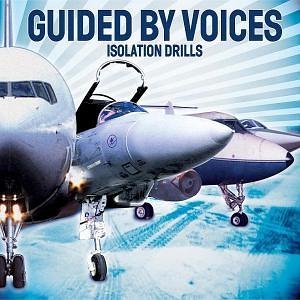
GUIDED BY VOICES LEARN ‘ISOLATION DRILLS’

FOREWORD: Simply put, Bob Pollard, leading light for Guided By Voices, is the most interesting and funny interviewee you’ll ever meet. The stories he’s got are outrageously entertaining. And he exemplifies rock’s DIY lo-fi aesthetic better than anyone, releasing shitloads of albums under the GBV banner and, more recently, as a solo artist. I had dinner with Bob and his band in Little Italy during ‘01, when they were playing Bowery Ballroom in support of Isolation Drills. I’ve spoken with Pollard on several occasions. Look for ‘02s Universal Truths And Cycles and ‘03s Earthquake Glue, two worthwhile late-period GBV works, in addition to the recommendations made below. This article originally appeared in Aquarian Weekly.

Besides being a major league beer drinker, here’s a few jock-related facts you might not know about Guided By Voices mainstay Bob Pollard. First, he pitched at least one no-hitter at Wright State. Second, he was a damn fine high school basketball player. These are things you only find out hanging around his brew-guzzling crew while eating clam pizza.

A serious vinyl junkie and avid Who fan, Pollard got his big break after grunge hit big in ‘91 and lo-fi enthusiasts Lou Barlow and Liz Phair reached unprecedented underground rock heights. Currently hooked up with former Gem bandmates Doug Gillard (ex-Death Of Samantha), rhythm guitarist Nate Farley, and bassist Tim Tobias (along with newest drummer, Toronto-based Jon Mc Cann), the latest edition of GBV recently unleashed the dynamic Isolation Drills. Produced by like-minded, free spirit Rob Schnapf, Isolation Drills brings back the loose studio feel of ‘97s Mag Earwhig.

“We enjoyed working with Ric Ocasek (ex-Cars) on the last album (Do The Collapse). But he had a no drinking policy in the studio.”

Yet despite Pollard’s continual debauchery, he finally felt secure enough to share a broad spectrum of hitherto unrealized heartfelt emotions. Isolation Drills faces inner turmoil, insecurities, and joyousness head on with a deep-rooted lyrical expressiveness usually reserved for acoustic folk artists. The bright, jangly “Fair Touching,” the reflective “Twilight Campfighter,” and the schoolyard crush of “Chasing Heather Crazy” offer wonderful insight. But Pollard’s still not afraid to flaunt his playful side on “Want One?” and the punchy, Big Star-like “Glad Girls.”

The night after a packed-like-sardines Bowery Ballroom show featuring the whole new album in its entirety (plus varied faves from the recent past), I met up with Pollard and company at TVT headquarters to down some Buds and share some stories.

AW: So whatever happened with the Rolling Rock venture we spoke of a few years back?

BOB POLLARD: We were going for the endorsement. Every night drinking Rolling Rock, just living it. Which can kill you very quickly. Just to get free beer we thought Rolling Rock was an easy target. But then we played a show in Athens, Ohio, when the Rolling Rock official came. He checked us out to see if we were worthy, but we didn’t get the endorsement and I’m glad ‘cause that shit gives you the nastiest farts the next day.

How has life on the road changed since the early ‘90s?

At first I didn’t like it. It was brutal. But I grew to like all aspects of being on the road. I didn’t like going eight hours from town to town, but now I use that as a period to relax and get over hangovers and read. It makes the tour go a lot quicker.

How do you deal with multiple hangovers? Don’t you drink water before going to bed so you don’t dehydrate?

You just tough it out. If we did a show without getting drunk and wild what would the people think. It would suck. Nathan said he’d boo me! In ‘87, Mitch Mitchell (former bandmate), my brother, and me would wear our Northridge varsity jackets because it stood for our band, the Needmores. We had to drink Colt 45 and smoke Camel non-filters. I got them both hooked on smoking cigarettes and I feel bad about it. (laughter) Now, their lungs are all clogged and they gasp for breath and go, “you fucker.”

Do you ever write songs while inebriated?

I don’t write the songs drunk. I write them in the morning when I’m drinking coffee. I just want to get drunk and talk to people at night. I feel more motivated in the morning. This past year, we were gone forever and were away from the people we love. At the end of the tour, I drove from San Diego to Athens, Georgia. I got pretty introspective and started writing reflective lyrics about what was going on with us. When I wrote the songs in ‘94/ ‘95, they’d be about werewolves and witches…

And that damn “Kicker Of Elves.”

Right. I was happy and silly and hanging around kids. (editors note: Pollard was an elementary school teacher) I like to write lyrics first because it’s much easier to match the music up to the lyrics. Then the lyrics are gonna be good. If you write the melody and the music first, you have to fit lyrics to that and it’s not as good. So this became a dark record. It’s uplifting, too. I mean, it’s not Joy Division or Lou Reed. It’s still us.

So how does Isolation Drills differ from the previous album?

Ric Ocasek doesn’t drink, so we had to play sober (on Do The Collapse). But Rob is more like us so we drank and smoked. The atmosphere was more laid-back and we got better performances. I wrote about 35 or 40 songs for Do The Collapse, but there were a few good ones left off the record that we used now. These songs are stronger than the ones on Do The Collapse.What have you been listening to lately?

It took about three weeks to make 75 ninety minute cassettes – close to 150 albums – of the best albums from ‘67 to ‘70. (note: Moby Grape’s debut and early Little Feat didn’t make it)

When did you get hooked on collecting records?

My dad let me choose the twelve for a penny Columbia House albums. Then, I’d get money by any means I could. In high school, I’d skip lunch and keep the money for records. Afterwards, I’d have basketball practice and I had to survive on a pile of sliced pickles from the cafeteria. That’s how I saved up for Quadrophenia. My dad finally said, “I don’t want another god damn record coming in my house. (laughter)

Radio was cool back then. Even pussy pop songs had hooks and were only two and a half minutes. You should know about two and a half minutes, Bob!

(cracking up at that insightful wisdom) I’m gonna have to remember that one! I am the king of two-minute pop.

Now Bob’s gonna get all stuck up. (jokingly) So when are you gonna dump the current band?

Never. I love ‘em.

Now you know he’s full of shit!

I can’t imagine them doing anything to get kicked out unless they fuck up the schedule of events. Should I tell him the ‘Calvin’ story.

(10 minute tape gap before picking up a different story ‘bout Bob’s donkey-dicked high school baseball coach)

My team would tell me about it. They’d say, “you’ll see it.” He’d wait for you as you’re coming out of the shower with your little dick. He walks up to you and it just sways. (hysterical laughter)

Is that around the time you started your first band?

In ‘76, I had a heavy metal band called Anacrucis (fuck the spelling). I didn’t even know how to play guitar then. We kicked up Sabbath’s “Paranoid.” We did The Who’s “Behind Blue Eyes.” We did a bunch of Cheap Trick songs from the first album before they made it big. People thought they were our songs. We’d be driving down the street with Cheap Trick playing and the guy who owned the bar we played at would hear it and go, ‘Those guys are ripping you off!’ We did “He’s A Whore,” “Hello There,” and “Down.” As it turns out, it was important for me to get up on stage to develop confidence.

So what’s next for Guided By Voices?

More touring and more recording. I still have a lot of good leftover material. It’s all about the songs. If you don’t have good songs, it doesn’t matter how well you produce them.

HIT IN THE HEAD BY THE FUTUREHEADS

FOREWORD: I was sucking down some Amstel Light’s at Manhattan’s Canal Room on a weekday night when I got to meet the Futureheads, one of my favorite new bands of 2004. Leader Ross Millard was very forthright  as we chatted prior to the bands’ winning set. Afterwards, ‘06s News And Tributes could never match the energy level of the Futureheads impressive self-titled debut, but ‘08s This Is Not The World nearly did. This article originally appeared in Aquarian Weekly.

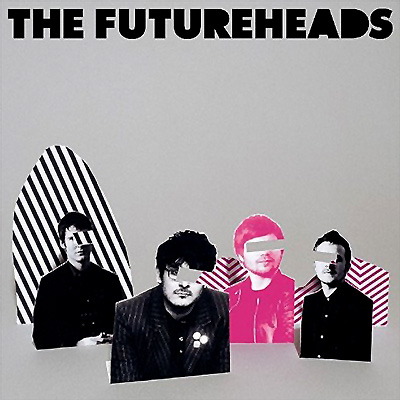
Meeting at Newcastle University as teens, Britain’s quirky Futureheads have made heady waves with their vibrantly infectious punk-carved art-pop. Trouncing irresistibly subversive chants with romping dual guitar razzle dazzle, jumbled herky-jerky rhythms, and atomic abstract dissonance, the fearlessly frolicking foursome chuck hiccuped barks, snickered barbs, and clipped utterances against a mightily saturated rumpus.

Happily mastering the thumping pogo bounce cadence ‘80s new wave funksters Devo and XTC once employed, these keen embryonic interlopers dexterously construct precision-guided high-strung aberrations while displaying a fascinating knack for sharp hooks.

Fidgety automaton opener “Le Garage” and its jittery supplement “Robot” introduce the Futureheads vital eponymous debut by brandishing hilarious deadpan merriment without getting bogged in the misanthropic silliness Devo required. Searing axe work propels the riveting, “Carnival Kids,” a blared slam jam intensified by blurted choral shouts. Inversely, radiant a cappella multi-harmonies reminiscent of the Beach Boys’ Pet Sounds adjoin a one-note keyboard line on the startlingly deviating exhortation “Danger Of The Water.” The fidgety “He Knows” proves contagious, borrowing XTC’s choppy palpitating vocal schematic to energize a spastic groove. Saving the best for last, ticking time bomb “Man Ray” spins mindlessly out of control as deliriously boggled voices charge forwardly askew.

At Manhattan’s quaint Canal Room, the Futureheads invade the strong sound system with frantic 6-string friction and stampeding rhythms. Stabilizing force, dark-haired guitarist-singer Ross Millard, the huskiest of the tall frontline assemblage, fills stage right with stammering riffs and ample wattage. To the left, nimble bassist Jaff flaunts dizzyingly freakish mannerisms. Standing center, blonde singer-guitarist Barry Hyde’s spurted squawks and charismatic eloquence dominate, as he thrusts gas-faced expressions at the appreciative audience while swiveling his elastic hips in time. Behind them, Barry’s flop-topped brother, drummer Dave Hyde, drips sweat on to his bashed skins. Television Personality’s “Dorian Gray” received a smacked-up rendering but the crowd was clearly most ecstatic over obvious highlight, the peppy “Decent Days And Nights.” For their rumbling encore, non-conformist ‘eat shit’ percolator “Stupid & Shallow,” cynically dedicated to George W. Bush, sufficed as a post-election day blues ruse.

Take me back to the Futureheads first release, “Nul Book Standard.”

ROSS MILLARD: That was a 4-song EP. Two tracks, “Robot” and “First Day” were re-recorded for the album. The other two tracks were kicking around from the earlier days but we don’t do them live anymore. It was recorded in our rehearsal space. It didn’t cost anything to make. We just botched it up, but a guy from Rough Trade Records in London asked if we wanted to be the first release on his self-made bedroom label. So he pressed up a bunch of singles that collided quite nicely with our first tour of Hamburg squat clubs a couple summer’s back. For our first tour we had the double whammy of being on the road for the first time and having this seven-inch record to sell. That was our first experience getting press.

What was it like growing up in Sunderland?

It’s a quiet place. England’s the sort of country where London’s a busy place and the media industry and record labels are all over. That’s where bands go to play their big showcase gigs. The further North you get, the more it becomes raw industry. Where we’re from it used to be shit buildings and coal mines, all those traditional British manufacturing based jobs. As those industries collapsed in the ‘80s, it left a lot of unemployed people. In certain areas, people are still feeling the effect. It’s more car manufacturing now. It’s not a happening place. It’s bleak, not that our area was particularly bad. That’s the way it is all up there – barren. When I was growing up, there wasn’t much to get into except music. I discovered some cool bands when I was real young. I chose to learn to play guitar. Where I went to high school, I couldn’t meet any people interested in forming a band. So I picked up the guitar as something to do with my time after a day at school. By the time I went to college, I met people in a similar position. We gravitated towards a youth project in the center of town aimed at putting kids in different areas together to encourage collaboration. It was a great thing, like a government initiative project. If it hadn’t been for that, we wouldn’t have met and there’d be no Futureheads.

I was studying while the three others were working jobs. We slowly put together some songs but didn’t even consider ourselves a proper functioning band until we came back from the German tour. Before that, we played only in our hometown. It was quite a dramatic change. But at that time we decided to ditch the day jobs and give music our full attention, even if we were gonna be on a DIY scale booking our own tours to raise money to make our own records.

What bands influenced you while growing up?

The first band I got into that I really loved was REM, just before Out Of Time came out, when “The One I Love” was on the radio so much when I was eight. That band got me into indie music. As I got older, it’s all the Brit-pop like Blur. That inspired a lot of people to play guitar and give it a go. It seemed so easy. You hear the same four chords in every Oasis song so everyone thinks they can write songs. Looking back, I don’t appreciate Oasis as much, but that was still an important time to get into rock.

Oasis proved emotionally compelling harmonies and great melodies still had a place on Top 40 radio amongst kiddie MOR crap and hip-hop.

The first song we did, for six months in the band, we practiced it, shouting over guitars. It wasn’t that developed in the beginning. But the more you play, you just slip into feeling it a bit more and you can all of a sudden sing in tune and it becomes more natural. Sometimes someone will come in and shout something we could use or someone else will ad lib lines. That’s the most fun of it. Live, we want it to be like watching tennis, where your eyes are all over the place. You won’t focus on one particular person. For a long time, the only thing we had was the live show. We wanted to get better at getting songs down.

I remember seeing Mercury Rev on the Deserter’s Song tour when I was 17. I was excited. I’d never seen them before. You go, and the songs are amazing and the album’s fantastic, but they played slightly too long. You start looking at your watch, thinking ‘that’s not what we want happening at our shows.’ There’s a huge sense of disappointment. It’s much better having people wanting more. Then again, most of our songs last only a minute and a half. (guarded laughter)

How are the new songs your working on coming along?

Maybe we’ll make them a little less cluttered. We want to strike a good balance.

LANGHORNE SLIM’S ON THE BRIM

Image result for langhorne slim

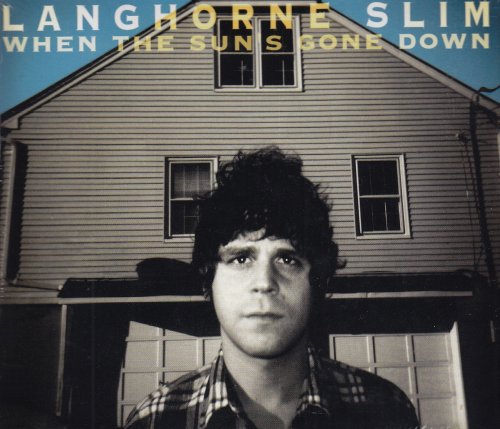
FOREWORD: For a couple weeks there in the summer of ’05, I became friendly with mod folk rascal, Langhorne Slim. I caught a few shows (one with my college bud, Jeff), quaffed a few brews, and took some quotes on the run. His self-titled ’08 album is nearly as good as ’05 long-play debut, When the Sun’s Come Down. This article originally appeared in Aquarian Weekly.

Tackling interpretive folk and talkin’ blues in a dignified roots-y rock manner, young buck Langhorne Slim proves a simple song goes a long way. Taking his adopted first name from the rural Pennsylvania town he departed following high school, the sprightly Slim (a.k.a. Sean Scolnick) feels perfectly at home composing scanty hobo lullaby’s, convivial old timey treatises, and assiduously finger picked hillbilly hoe-downs.

Drawing a passing resemblance to soulful Philly peer Amos Lee, the adroit Slim delivers post-adolescent confessionals in a slightly nasal tone prudently located to the right of strangely scraggly baritone grumbler Tom Waits and wild West Virginian warbling weirdo Hasil Adkins.Leaving the agrarian farmlands of Bucks County to attend SUNY-Purchase in Westchester, Slim then moved to Jersey City and Brooklyn before settling in New York’s Chinatown district with his girlfriend.

Brought up by his mother and grandparents, he discovered theatrical soundtracks, Jazz, and Barbra Striesand as a child. On Sundays, his divorced father would visit, exposing him to Chuck Berry and the Rolling Stones.

“I’ve seen Richie Havens live more than any other performer. Last time I saw him, he played a haunted Pennsylvania hotel. His hands are enormous. Because he didn’t break any strings banging away I asked what kind he used. He said, ‘D’Addario,’ so I’ve used them ever since. But I break them all the time. In fact, when Havens was at Woodstock, he broke a bunch during “Freedom.” He plays in such a rhythmic way,” Slim instructs. “As for Doc Watson, he’s maybe my favorite guitarist. I find comparisons to him to be huge compliments. Tonight, someone said early Dylan. However, that’s probably only because he played acoustic guitar and took inspiration from the same American folk roots music.”

“My grandfather taught me about Lionel Hampton and I was doing community theatre – Guys & Dolls and famous ancient plays – but I was never any good at being directed, so I decided to make my own kind of show,” Slim shares. “At thirteen, I picked up a guitar and began writing.”

After college, Slim made minimalist self-released home recording, Slim Picken’s, with friend Charles Butler on banjo. Soon, indie label Narnack signed him for the introductory Electric Love Letter EP, a less laid-back, more festive, yet hastily assembled project that gained the attention of neo-traditionalists and anti-folk contemporaries alike. Slim’s eyes light up when compared to interpretive post-Dylan strummer Richie Havens and bluegrass icon Doc Watson.

Onstage at quaint NoHo Manhattan club, Joe’s Pub, his unwavering confidence, facetious wit, and quickly quipped asides kept the seated audience captive. Allowing for some minor eccentricities, pork pie-hatted Slim donned an ash-colored velour shirt while quivering through melodramatic sad songs, keeping tongue firmly in cheek during several impish curiosities.

Slim’s cracked bari-tenor, expressive if not rangy, brought a delicate chill to poignant allusions and a relaxed playful demeanor to milder sentiments. Prancing across the stage strumming fast jangled chords, he had the sanguine saunter of a salty troubadour, spitting exasperated verbiage and relating silly anecdotes when not busy fronting the bare-bone rhythm section (bassist Paul De Figlio and drummer Malachi De Lorenzo). He put on the gas face or wore a goofy smirk to squeeze more passion out of each whimsical piece.

A week later at Maxwells in Hoboken opening for Crooked Fingers (ex-Archers Of Loaf guitarist Eric Bachmann’s pensive solo venture), the skinny Semite, dressed down in guinea-t and casual gray slacks sans band, attempted fewer new songs, unleashing a short itinerary of older material. Adding rambling interjections and funny narratives to keep his repertoire fresh, Slim tries to never play originals the same way twice, much like mighty icon Bob Dylan. Yet Slim admits he could listen to AOR standards such as The Who’s Baba O’Riley (“teenage wasteland”) every day without hesitation. Plus, he gives respect to another well-known ‘60s Brit-rock crew, the Kinks, whose “Waterloo Sunset,” he adores.

“I think the Kinks deserve more credit. Ray Davies is the man, but I think he pissed off a lot of people.” Slim grins then remarks, “I was humming “Happy Jack” after hearing it on a television commercial and actually met someone claiming he didn’t like The Who. Who the fuck wouldn’t enjoy The Who?!!”

But despite his admiration for revolutionary post-Beatles archetypes, truth is, Slim’s Narnack Records long-play debut, When The Sun’s Gone Down, is indubitably informed by traditional Country blues, rustic bluegrass, and Dust Bowl era ballads instead of any weightier classic rock impetus.

Spindly acoustic and expeditious banjo linger above bustling percussive beats on urgent love-struck opener “In The Midnight,” breezy affectionate gush “The Electric Love Letter,” and hokum organ-splashed hootenanny “Set Em Up.” Chiming pedal steel-aided adoration “Mary” and shuffling fiddle-ensconced “Loretta Lee Jones” maintain mint-y freshness. The latter recalls Buddy Holly’s zippier rocking snapshots while retaining a concise folk-y resonation.

Though oft-times lyrically obsessed with solitude, as per abrupt harmonica-fuzzed chant “And If It’s True” (‘I was alone but not lonely’), brusque lo-fi scruff “Drowning” (‘I’d kill to be alone’), and the scratchy tear-stained drifter’s lament “I Ain’t Proud,” he downplays any significant underlying defeatist attitude with restrained jocularity.

“I’ve been in a few relationships so I sing about the painful aspects, which is easier than sharing the happy parts,” he advises.

Akin to its humble back porch serenity, the sumptuously bucolic When The Sun’s Gone Down artwork appropriates suitably modest black and white dusky photographs.

Slim asserts, “The front cover features my friend Mike’s Jersey house. The back shot is from the house I grew up in. Inside, there’s a puzzle of the world’s strongest man, Louis Cyr, which my father, an amateur body builder, left in the basement when my parents split, along with the sailfish on the paneled wall.”

Nevertheless, when all is said and done, it is Slim’s pliable perspicacity of every man’s joyous wonders and, conversely, isolationistic defeats that seep deeply into the mind. And when an existing arrangement needs color splashed on for a cheerier mood swing, Slim goes and fetches accordionist Brendan Ryan to perk up verbose assurance, “Hope And Fulfillment.” In summary, he brings a greatened noble sense of integrity to a bygone generation’s most fertile ideals, whether ceding down and out allegories or rendering snugly devotional keepsakes.

DUNGEN VAUNTS TWO NORDIC PSYCH-GARAGE FREAKS

FOREWORD: Dungen have to be one of the most inventive bands to come down the pike in recent years. I interviewed dexterous guitarist Reine Fiske just before ’05s Ta Det Lugnt took hold underground. I’ve also included a High Times review I did for ’07s incredibly awesome Tio Bitar – which received a four hemp leaf rating, as you’ll see below.  This article originally appeared in Aquarian Weekly. The brainchild of multi-instrumentalist Gustav Ejstes, Nordic combo Dungen (pronounced doon-yen) came into existence in its earliest version as a one-man band aided by several eager school pals. A farm-raised southern Sweden villager, Ejstes studied with accomplished local fiddler Jonny Soling, a significant mentor and role model.

After meeting ambitious lead guitarist, Reine Fiske, at folk school, the stage was set for Dungen to develop into one of the most meaningful experimental bands’ now cavorting through the universal nightclub scene. Originally, Dungen fooled around with different chord structures, exploring the catalog of Jimi Hendrix Experience at intervals, deftly attempting to figure out the dexterous psychedelicized fretwork as well as Mitch Mitchell’s thunderous drumming in a dank, dusky basement.

“I was forced to play guitar in music school,” the fleet fingered Fiske recalls. “Sweden used to have a scheme where if you’d pick up an instrument and join a band the government would pay.” But he promptly confesses, “Ultimately, it’s all in your system. I’ve been programmed with so many things. I don’t consider myself a very blues-y guitar player. I’m more into melodies. You always indirectly borrow ideas from people, but in the end, they’re your own.”

Dungen’s limited edition fuzzed-out ’01 self-titled vinyl debut sold out its initial 500 copies, and along with their more cohesive second album, Stadsvandringar (described as ‘a promenade with observations on city summer life’), has been re-released on CD with unreleased material added, creating quite a stir amongst well-informed subterraneous residents. Could fame on par with fellow Scandinavians the Hives, or at least Sahara Hotnights, be far off?

Fiske may laugh at the thought, but he offers, “I’ve been into Swedish underground music forever. The first incarnation of International Harvester (whose feral fusion of raga, folk, jazz, and nature sounds coalesced best on ‘68s dependable Sov Gott Rose-Marie) played complex, haunting drone-rock with tribal beats. They were a very big cult band in a more free form improvised genre.”

Though denying any first-hand prog-rock influences, Fiske admits to having early Yes albums in his collection, albeit not the late-‘70s symphonic investigations of Tales of Topographic Oceans. He finds beauty in some of it, but has otherwise “grown tired of it.”

Yet the self-assured young maverick does touch upon some enthrallingly proggish inclinations, as he noodles around abstrusely, moving through wacky offbeat dementia and outrageously fanciful excursions in increasingly intriguing ways. Gratefully, notwithstanding the fascinating tripped out hi-jinx daubing a few clever suites, ‘05 breakout, Ta Det Lugnt, finds Dungen remaining surprisingly affective constructing euphonious hook lines and subordinate symphonic orchestral grandeur; mutating cosmic styles while astonishingly singing in their native tongue instead of commonplace English. Piercing trebly guitars reach punk-metal pandemonium during unexpected intervals, subverting several protracted decorous extravaganzas with spacey electronic manipulation any old school King Crimson fan would recognize. However, at the core of these galactic expansions lie the hearts and minds of true garage-rock freak’s resourcefully handling primal studio gadgetry and primary tools (guitar-drum-bass).

“It was cut together as a montage. We worked real hard on it. Certain movements are spontaneous. The jams blend together,” declares Fiske. “The last song, “Sluta Folja Eiter,” has Gustav on all the drums during a heavy night. We were just drunk, had a good time, and were loose. I put the guitar notes down and it was crazy. Nothing but the basic track was planned.”

Even if, as Ejstes claims, Ta Det Lugnt was made in the midst of an angry drunken stoner hangover, its nervous tension allows room for multitudinous spiffy pop embellishments. Unconventionally beginning with a nifty swing-styled drum solo, the upwardly mobile sorcery of “Panda” imbues a similar celebratory European harmoniousness ‘60s legends, the Monks, once exposed. Perhaps another hazy reminder of a long-lost psychedelic-crazed Sixties relic, the echoed vocals and six-string sustenance fortifying the congenial “Gjort Bort Sig” reference The Creation, aiming at the frazzled skull before heading straight to the stratosphere. Folk-acoustic spiral “Festival” then settles into the semi-aquatic neo-orchestral glaze of emotional ballad “Du E For Fin For Mig” (where Fiske’s fiery guitar coda seemingly mingles Hendrix distortion techniques with dazzling Frank Zappa-sponsored fluidity). And the soothing “Lipsill” slips into voyaging lounge-y ambiance better than the velvety piano-strolled morsel “Det Du Tanker Ideg Ar Du I Morgon.”

“There’s always a kernel of hook-y melodies – something to grab onto,” Fiske shares. “When I listen to the record, I get very connected to the way the record turned out. The mixture of songs is interesting. There are all kinds of moods that go lots of places you couldn’t imagine. New things are happening all the time.”

Even while rejecting the notion that the mid-section of barreling sashay “Bortglomd” touches upon some swiftly stroked riffs drawn from The Who’s Quadrophenia, Fiske does unequivocally acknowledge their windmill-armed axe master.

“Pete Townshend was important for me as an angry teen not knowing what to do. But I wasn’t thinking about them. Instead, the inspiration comes from certain (established) Swedish bands. The drum patterns were from a jam.” He continues, “We function well together in a recording situation. I’m handy in the studio. Live, to some extent, we’ll break into jams. There are times we head off in any direction.”

Dungen have been recording some new ideas, but no particular songs have been finished yet. Will Fiske risk the venture into solo artist territory in the near future?

“I’m not a song man. But it’d be nice to get together with people I love and have he same attitude towards playing. I’d definitely want good people,” he avows.

Best of all, Dungen has already caught on here in the States thanks to a recent spate of nationwide club dates. At Maxwells in Hoboken this September, Fiske, whose frizzy shoulder length blonde locks covered his bespectacled face, displayed technical proficiency way beyond his twentysomething years. Curly-haired Ejstes, meanwhile, did yeoman’s work adding rhythm guitar segments, manipulating keys, shakin’ tambourine, providing decorative tidbits, and taking on lead vocal chores. Bassist Mattias Gustavsson held the fort as athletic drummer Fredrik Bjorling proved to be mightily sufficient banging out engrossing rhythms and perplexingly distended fragments. Mars Volta’s fabulous protracted jaunts came to mind as well as Soft Machine’s strenuous Jazz-informed free form meanderings (especially on spectral flute-interspersed epic “Om Du Vore En Vakthund”). Only a little blurry over-modulated distortion during the dramatic harmonic refrain of “Panda” marred the otherwise magnanimous set.

Fiske concludes, “We did two weeks in America in July. We basically sold out the smaller venues. We got good press, too. It’s almost odd how we got that kind of exposure.”

—————————————————————————

DUNGENTio Bitar(Kemado Records)

4 hemp leafs

Reclusive studio rat Gustav Ejstes may shun interviews and appear shy onstage (despite the beautiful noisy racket he creates), but the industrious multi-instrumentalist cannot be denied his place amongst the top modern rock surrealists. Masterminding Swedish combo Dungen (pronounced doon-yen) with a little help from fellow Nordic hotshot guitarist Reine Fiske (and an equally compelling touring unit), they blend myriad textural elements into a heady brew of kaleidoscopic psychedelia.

Coming off dazzlingly cosmic ’05 U.S. debut, Ta Det Lugnt (recorded in the wintry daze of what Fiske described as “an angry drunken stoner hangover”), Dungen’s latest resplendent offering, Tio Bitar, reaches a tantalizingly melodic pinnacle without sacrificing abrasive metal-edged angularity. Conveniently holding heavy-handed proggish tendencies in check, Dungen allow piercing sonic feedback, Goth keyboard drones, jazz-fusion percussive milieu, illustrious acoustic-violin tranquility, and fluttery flute nuances to paint a rich canvas of contrasting dark and bright hues.

Indirectly informed by Classical Swedish folk and singing in his native tongue, Ejstes may make music mag headlines for devising astoundingly complex arrangements, but it’s ultimately his majestic emotional linguistics that seal the deal. On autumnal piano-plinked climax, “Svart Ar Himlen,” Ejstes’ warmly mesmerized lyricism rings out clearly, conveying a universal message way beyond restrictive cultural boundaries. Moreover, during the siren “Intro” and then elsewhere in Tio Bitar’s blissful narcotic midst, Fiske lets his freak flag fly, showing off a full-on Jimi Hendrix compulsion by scattering a blurry cavalcade of sustained riffs, gruff turbulence, and jagged distortion into the most far-out abstractions. In summary, it’s a hip opiate-encrypted trip picked to grip the underground nation.

-John Fortunato