 Fragrant black and blueberry mouthfeel more pronounced than phenol-hopped cranberry souring. Metallic twang soaks up tart fruited candy influence to soapy blackberry finish. Needs thicker malt seepage and sturdier white-breaded spine. On second passing, ripe blackberry-raspberry fruiting had firmer honeyed wheat spine and grazing Mandarin orange, tangerine, and peach snip.
ST. LOUIS PECHE
 Cloying fruited lambic features roaring sweet ‘n sour peach tartness, but suffers from astringent diacetyl acidity. Syrupy peach thickness overwhelms vinous cider wasteland and tinsel-y apricot spritz to puckering citric acerbity.
ROCK ART DOUBLE PORTER SMOKED

(PENNICHUCK) FIREMAN’S PAIL ALE
 Simple biscuit-y treat. Obvious barley-toasted caramel malting counters dry hop-spiced astringency. Cardboard-y cocoa-powdered marzipan reminder has polite acidic bitterness and soft nuttiness of copper ale. Brewery defunct: 2010.
LEINENKUGEL’S CLASSIC AMBER
 Blatant phenol acerbity drains light-bodied easy-drinkin’ amber ale. Slender sweet-corned cereal graining, barren honey-roasted malt whimper, and desolate almond paste divergence weaken latent sour orange tang.
LAGUNITAS HOP STOOPID (I.P.A.)
 Mega-hop bitterness and appreciable 7.7% alcohol boozing never overwhelm sumptuous Imperial India Pale Ale. Bright piney nectar aroma suits ripe ruby red grapefruit frontage. Juicy apricot, apple, tangerine, and pineapple zing drapes latent woody dryness and mild floral accents quite effectively.
ISSAQUAH MENAGE A FROG BELGIAN-STYLE TRIPEL ALE
 Appealing sunny-hazed tripel in green 26-ounce wine bottle maintains lightly embittered white ale fruitiness. Prominent citric hop zest brings pink lemonade, red grapefruit, and pineapple tang to candi-sugared vanilla wafer midst. Cork-scented Muscat grape, Granny Smith apple, and brown pear nuances recline towards buttered Chardonnay finish.
BROOKLYN LOCAL 2 ALE
 Though lacking distinct character, cascading brown-bodied tan-headed Belgian-style dark ale (with yeast speckles) retains heartiness. Medicinal candi-sugared dark-fruited intrigue fades into fleeting cinnamon-spiced chocolate midst. Sour wildflower honey acerbity upends ginger-clove nuances as well as underutilized citrus peel bittering.
ATWATER VOODOO VATOR DOPPLEBOCK
 Wavering ‘high gravity dopplebock lager’ reminiscent of light brown ale or mild porter. Dark-roasted hop-embittered caramel malting picks up smoked molasses simmer and chewy brown chocolate-y whir. Recessive banana, cherry, and prune notes aid lilting barleywine swirl.
COOPER TEMPLE CLAUSE ‘KICK UP THE FIRE, LET FLAMES LOOSE’
FOREWORD: Out of Berkshire, England, came prog-rock revivalists, Cooper Temple Clause. Though less known in America since forming ‘round ’98, these prescient Brits knew how to effectively make lengthy jams that rocked out and rarely meandered. Their instrumentation, light years beyond unseasoned indie rockers, caused a minor revival of technical guitar efficiency and acrobatic playing a la Jimi Hendrix, Jeff Beck, and Jimmy Page. After this ’04 interview, they belatedly released ‘06s lesser Make This Your Own on a stagnant major label. By ’07, it may’ve been over for the boys, but future generations will come to appreciate their dynamic cognizance and multi-tiered complexities.
Standing out against the media-hyped balladic pop pabulum and melodramatic emo geeks getting mainstream love, awkwardly fanatical British idiosyncrasies Cooper Temple Clause have somehow found an eager audience ripe for their cunningly austere, nimbly executed rock abstractions. Relying on cleverly unraveled premonitions dug deep into diligently constructed settings, this durable Reading-based sextet designs elusive epics art-damaged headbangers and post-grunge anglers dig.
Taking their busy moniker from a straight-to-video film to avoid the single word name deluge of Brit-pop idols such as Blur, Oasis, and Pulp, Cooper Temple Clause laid down their first spontaneous tracks for two formative EP’s at a windowless pig farm converted into a backwoods studio. The first, Hardware, includes concert staple “Devil Walks In The Sand” and lovely ballad “Sister Soul” while its impulsive follow-up, Warfare, sports the nifty instrumental “Mansell” plus an early acoustic take on the mighty “Panzer Attack.”
But it was ‘02s ambitiously diverse See This Through And Leave (made in a proper studio), with its co-mingled Krautrock-sniped electronics, techno-Industrial beats, free Jazz integrity, and metal-edged defiance, that put these gangly schoolyard chums in England’s Top 10. Lead singer Ben Gautrey, guitarist-lyricists Dan Fisher and Tom Bellamy, plus bassist Didz Hammond, keyboardist Kieran Mahon, and drummer Jon Harper, decisively challenged preconceived notions of studio authenticity by creating daringly serpentine arrangements gratefully lacking expendable overblown solos. Due to some silly visa photo shenanigans, Cooper Temple Clause never got to tour America for this precocious masterpiece.
Instead, the belated American debut, ‘04s hauntingly confounding Kick Up The Fire, And Let The Flames Break Loose, finds the adventurous combo moving further away from conventional rock territory, maintaining the absorbingly languid moodiness prog-rock scapegoats Pink Floyd and Radiohead explore alongside the roughneck resilience bluesrock dissidents Led Zeppelin implore. Throughout, Gautrey’s portentously downtrodden lyrical disposition arouses suspicion, as the despairing Love-struck “The Same Mistake” transiently fades into the galloping, yet caustic, psychedelic choral anthem “Promises, Promises” and the conscientiously implosive Goth-derived “New Toys.” Enduring hemispheric mellifluence, the uncompromising 10-minute neo-Classical “Written Apology” builds to a loud, thick crescendo, as saloon piano plinks and orchestral synthesizer lushness re-invigorate mounting dramatic tension.
I caught up with the otherwise good-humored Gautrey as he was “getting domesticated” just days prior to recording what will become CTC’s third full-length.
AW: How will your third album differ from previous endeavors?
BEN GAUTREY: We’ve come a long way from being six mates mucking about not taking responsibility for their actions. (laughter) To be honest, the way we write, it never goes according to plan. We’ll have to see what happens. With the second album, we realized a sense of melody in the band that was lost on the first album. So we tried to get a stronger melodic sense. We’ll try to make the third record more punctual. We’re looking for songs that work live because with Kick Up The Fire the songs were born out of the studio. So we never got a chance to amend the songs. We built them up with the flow and went with the spirit and how it felt. We had to learn to transpose them live when it came to touring the record. So we want to get that sort of energy back in the studio.
Throughout Kick Up The Fire, your band employs succulently eerie moodscapes and ethereal movements to perfectly counter louder, guitar-driven segments.
It’s a challenge. We always want to make each album sound different from the last. There’s only two ways to go. You could go for prog and make 12 to 15 minute songs which we can be real keen on with your ice skating and King Arthur-like Rick Wakeman or you could try to make shorter songs to see what happens. We definitely want to tour a lot so we want to make songs that work live. Who knows? We could end up with epic songs.
You mentioned Yes keyboardist Rick Wakeman. I grew up loving prog-rockers such as Soft Machine, Hawkwind, and King Crimson. Do these bands affect your muse?
No. Out of all those bands we only have one prog-rock album. We’re into Pink Floyd. And even with Pink Floyd, it was only Pipers At the Gates of Dawn and Dark Side of the Moon that struck the six of us. Maybe The Wall, but definitely Pipers with Syd Barrett. He was a big inspiration for the band, especially Dan Fisher, our guitarist, who says Syd Barrett was his first guitar hero.
“Into My Arms” seems to have a surreal solemnity closer to Pink Floyd’s ’83 album, The Final Cut, which came later than the albums you discussed.
We didn’t get heavily involved with that one… Syd was featured in an Underworld video recently, which is quite strange.
I didn’t know that. Considering Cooper Temple Clause’s relative youthfulness, every member shows uncanny instrumental restraint.
We’ve played live more than any UK band. They use hype and the press machine to get rolling. They play maybe ten gigs to crowds of 2,000 because they’ve been praised by a magazine or hailed as the greatest band ever, whereas we didn’t like that and found that very fake. We come from the school of thought where we like to find out and make our own decisions if we like a band despite newspaper coverage. Some of our favorite bands tour a lot like in the ‘70s. Back then, it was up to the fan to go to your gig and determine if they liked you because you were available. A lot of these new bands aren’t available and you can’t get a clue if you like them until you buy the record.
How long has your band operated its own rehearsal space?
We had our first rehearsal space we could use whenever we wanted when we were 16. It was next to these pigs on the farm. But for the first album, we went to an expensive studio thinking it’d be amazing. You know, “Bohemian Rhapsody” was recorded there and sounded great. We realized by the end of recording that we didn’t feel comfortable. We enjoyed our own rehearsal space. For the next album, we moved around the corner from the pigs and next to the owls. We started building a studio, which was vital to pick up our own sound. We weren’t disturbed there. Nearest shops were five miles away. We were out of the way. It was difficult to leave. Just six of us and our producer without anyone else hearing it. No people turned up to disrupt or give their penny’s worth. It was a very honest album, more focused and coherent than the first. We had the great luxury to build, record, write, and mix an entire album. We’re going back to that studio Monday.
Did you have much time to record the first album?
We played local venues and got signed quickly. Half of it was written in the studio. There were three years between writing the first to last song. We’re proud of it but some songs felt out of place with each other. It’s disjointed.
There’s more unity, trust, and sense of purpose now.
We’re not scared to tackle different sonics because we’re such big fans of the music we listen to. That inspires us. We don’t want to be just a guitar heavy band. We want to create something new. We’re sick of bands from the last five years just aping styles from years ago. That’s so derivative and unexciting. Artists we admire, like Bowie, Aphex Twin, and Radiohead, try to do something new without becoming predictable. All of us write the songs. It’s a great mini-democracy. Some are into Sonic Youth, Pavement, Grandaddy, Breeders and Pixies. Others are into Godspeed! You Black Emperor or classic Hendrix and Led Zeppelin. The dance freaks are into Squarepusher and Kid Kaola, going back to Kraftwerk. Even grunge and Brit-pop edge their way into our music – from Nirvana to Massive Attack.
HILLY KRISTAL’S BOWERY HAVEN CBGB CLOSING
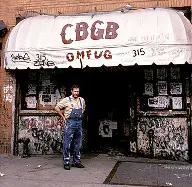
FOREWORD: I was lucky enough to be liked by CBGB head honcho, Hilly Kristal. I doubt he’d remember my name if he were still alive. But he knew my face.
When Kristal opened CB’s 313 Gallery next door around ‘92, he hosted Smug Magazine’s 1st anniversary party, where I met and got stoned with Steve Bloom, editor of High Times – which led to a 20-years-plus writing gig at the glorious pro-marijuana publication. Months afterwards, Kristal cleaned out CBGB’s cement-floored basement space, put in a pizza oven, and had cool parties and shows downstairs.
I remember how proud Kristal was when he showed me and my friend, Rich Farnham, the basement space. I had blood all over my white t-shirt from getting jumped by some sexless assholes upstairs earlier that night. But Kristal didn’t even take notice of the blood. He probably thought I was moshing.
High Times threw a great party in CB’s basement and I burnt Joey Ramones’ hand passing him a doobie. I also recall Steve Bloom stopping an ugly altercation from happening that evening. My friend, photographer Dennis Kleiman, nearly got his ass kicked for no reason.
I must’ve seen over a hundred shows at the now-defunct CBGB club. And I hung out with just as many kick-ass rock bands in the small backstage area.
Anyway, back to Kristal. I mentioned how he liked me. But he could be a tough motherfucker if he needed to. I remember neighbors got the club fined for noise and when someone opened the back door for air on a sweaty night, he pulled the door closed with a vengeance and seriously reprimanded the offender. He often hung out at the entrance watching television and playing bouncer – a true hands-on manager. He was a man of good size and he didn’t take shit. Needless to say, I miss that old son of a bitch now.
The following interview took place months before CB’s closed down in October 2006.
Lower Manhattan’s Bowery section may lose its most iconic hotspot, CBGB, the dingy landmark nightclub run by aged-in-the-wool entrepreneur Hilly Kristal. A rent dispute could force the closure of this hallowed dank space unless a judge sympathizes with transplanted New Yorker Kristal, an unlikely underground rock ally whose weathered face, rugged exterior, and large frame resemble a lumberjack instead of an independent music savior.
“BRC (Bowery Residents Committee Inc.) is my landlord. They don’t own the building, but they have 33 more years of a net lease for a non-profit organization. They save the homeless, got $30 million from the city, state, and federal government last year, and paid the owners a stipend. There’s flop houses upstairs,” Kristal submits.
Studying Classical music in Philadelphia during the ‘50s, Kristal lived on a Central Jersey farm, studied opera, got to sing at Radio City Music Hall, managed Manhattan’s Village Vanguard (meeting legendary Jazz figures Miles Davis, Cannonball Adderley, and Carmen Mc Rae) before working for Ron Delsener’s Central Park Music Festival.
By the early ‘70s, Kristal opened still-thriving venue, CBGB, whose initials stood for Country BlueGrass Blues. Soon, a bunch of unkempt young musicians took advantage of Kristal’s policy of playing original songs as the obliging proprietor offered Sunday evenings for the fledging locals to develop their craft, helping the burgeoning punk scene get its propitious initiation. The Ramones, Talking Heads, Blondie, Television, Dead Boys, Heartbreakers, and a host of less-known acts got their first true exposure at Kristal’s rustic, unfinished venue, giving hope to inexperienced talent willing to breakaway from the snobbish exclusionary prog-rockers then clogging flailing mainstream American radio.
These minimalist marvels embraced the simple, elementary ‘50s approach towards rock and roll, bashing out compelling, if instrumentally rudimentary, tunes for a small audience of anti-hippies, neo-hipsters, social outcasts, and curiosity seekers. Intrigued by the virtue, persistence, and work ethic the early roughhewn punks revealed, Kristal continued booking bands whether or not they had signed record deals. By the late ‘90s, Kristal had expanded CBGB to include adjacent CB’s Gallery and an oven-kitchen basement space, CBGB Lounge, for parties and events.
“One of the bars inside CBGB may be the oldest in the Bowery. Next door and downstairs I built myself. It was good for therapy. Knocking down walls with a sledgehammer. It’s like taking out frustrations on someone you hate,” the straight shootin’ Kristal divulges.
Critical music listeners found the greatest drawing card to be CBGB’s powerful sound system, constructed precisely for their discriminating ears.
“Way back I got Charlie Martin, who still lives around here, and Norman Dunn, to build it,” Kristal offers. “Now we have a system places two to three times bigger would love. We have a lot of headroom, which specifically means, you don’t run it all the way up. You could play with it at lower levels to tune in and get the best sound. Also, the shape of the room – elongated – allows for better sound because there’s enough clutter, beer signs, posters, and plaster, that breaks it up and adds to it. I paid for that sound system for over ten years. Even today, record companies want to hear and record their bands here.”
Though Kristal’s club continues to prosper, and as CBGB boutique clothing line gains a foothold in the apparel market, the owners of 311 and 313 Bowery have now proposed an exorbitant rental hike threatening current operations.
“Last spring, three representatives cam around and said, ‘After we get the Certificate of Occupancy, we’ll be asking $55 a square foot,’ which adds up to $38,000 to 40,000 per month,” Kristal explains. “As of now, the only money owed is in the hands of a judge. No one could touch it. Over three years, we didn’t get a bill, but we paid rent. Each year, it went up a little bit. Come February, they said we owed $95,000. That includes interest. My attorney said, ‘You don’t know if you’re gonna get a lease.’ So now it’s in the hands of a jury. The judge told both parties he wants to work it out and said they can’t charge interest on money not being billed.”
When asked if he’d like to retire from the business, Kristal shoots back a puzzled look and asks, “Why?”
“When we started CBGB, Country was not just Nashville. It included folk and early Bob Dylan as part of the scene. Bluegrass had a lot of fiddlers conventions. Folk was at the top of the charts, but now the people doing that type of music are considered alt-Country.” He further recalls, “There were still bums and derelicts hanging around so it didn’t really work out. I gradually got into Jazz bands until discovering all these new bands that didn’t have anywhere else to play. Everything was easier in the ‘70s. But I made a policy that the only way you could play here was if you made your own music. That’s not a way to make a lot of money, but my interest was devoting time to developing talent, no matter how crude. The Television and Ramones Sunday evening shows. Later on, we did hardcore on Sunday afternoon to get the kids out. It was good.”
Kristal looks back with fondness highlighting some of the great moments CBGB entertained. “When the Shirts and Talking Heads auditioned the same night, to me, it was wonderful. They both had a way to go, but that was a major happening. One recent memory was John Cale (ex-Velvet Underground) during the Christmas season playing two sets, one at 2:30 AM. They wouldn’t let him off the stage. It was packed. Finally, he got out his cello.”
One of the crazier nights he remembers was when outrageous locals the Dead Boys blew English punks, the Damned, off the stage. Also, the Plasmatics, led by breast-y powerhouse Wendy O. Williams, often fascinated Kristal. But it may have been Patti Smith’s early ’74 shows that put the club on the map shortly after its December ’73 opening. One thing all these acts had in common was bringing unbridled enthusiasm back to what was fast becoming a stale rock scene. Though Smith, Jon Spencer Blues Explosion, and Country star Alan Jackson have recently sold out CBGB, its main function continues to be exposing newer, less renowned artists. Kristal’s genuine affection and appreciation for hungry acts remains admirable. He has audaciously avoided being a corporate sell out, holding on to integrity much the same way the Ramones, Patti Smith, and Talking Heads have.
Though cigarette companies, at times, have offered substantial advertising dollars, Kristal never accepted their proposals. On a related issue, he says, “I don’t smoke now, but I used to smoke four packs a day. At first, I didn’t like the way the mayor banned smoking in clubs, but it is working.”
A sincere humanist, Kristal retains a mild modicum of anti-establishment idealism. That same enduring individualism extends to his thoughts on political topics. Kristal is at odds with the city’s handling of noise pollution despite crediting former mayor Giuliani for lower crime rate.
“Giuliani was lucky New York’s economy reflected the country’s in ’92. Then, he found national recognition for the way he handled 9-11. He spent lots of money to rid crime. The problem I see is with the apartments. He did things with too broad a stroke. He was a little careless and insensitive to the poorer population. He may have done some good things, but he worried about the sound of music bothering people outside the clubs. What about the sound of loud trucks going by?”
Recently, CBGB clothing and gear have gained international attention. T-shirts, hats, key chains, tote bags, etc. opened eyes at boutique shows at Manhattan’s Jacob Javitz Center, in Vegas, London, and soon, Barcelona. He sells to store chains and competes well against brand names and smaller competitors.
Just don’t fuck with the big ol’ man. I once saw Kristal get pissed off on a muggy July evening when a few kids opened the backdoor for fresh air. He slammed the door shut, yelled at the culprits, then explained how the noise (music) disturbed neighbors and drew police attention when the sound reached the alleyway.

Recently, Underground Garage host Steven Van Zandt and Nike have gotten into the act to save CBGB. The renowned Little Steven (solo artist/ Springsteen guitarist/ The Sopranos gangster) got his Renegade Nation to host a Million Pug March on June 11th as part of Project Save CBGB, steering clear of the rental dispute to focus instead on landmark preservation. Meanwhile, Nike got into the act and will stage a Central Park Run with entertainment provided by Joan Jett, the Donnas, and Fountains Of Wayne. They’ll donate $1 of each race entry to Project Save CBGB. Furthermore, Kristal is gathering some big name bands to play benefits in August.
With all this attention being paid to his club, how does a famous club owner spend his nights in the Big Apple?
“I go home and read a book or go to a movie or theatre with my girlfriend.”
NICK CAVE COMBATS ‘ABATTOIR BLUES’ WITH ‘THE LYRE OF ORPHEUS’
Foreword: I was very excited and anxious to meet fascinatingly gloom-obsessed artist, Nick Cave, in ’04. He had been leader of radical post-punk denizens, the Birthday Party, in the ‘80s, receiving further critical acclaim fronting the Bad Seeds thereafter. With his son playing compute games in an adjoining room, Cave and I had a demure conversation. It was a low key and quaintly informative session. After this interview, Cave gained wider audience acceptance under the guise of Grinderman, whose eponymous ’07 album was almost as tremendous as the Bad Seeds ’08 triumphant Dig!!! Lazarus Dig!!!


I’m sitting with Nick Cave at his exquisite 57th floor suite atop Ground Zero’s haughty Millenium Hotel in Manhattan as every wacky means of conveyance crosses by the half-curtained windows. There’s a blimp, private airplane, and glider hanging above the Hudson River, which is filled with a wandering tugboat, lumbering barge, and silver ship. Under the faded gray sky, these aircraft and vessels are nearly as striking, though not as barren, as Cave’s stark murder ballads, bleak tone poems, and vertiginous allegorical fugues.
An Australian rhapsodist living in England since the mid-‘80s, Cave gained underground fame leading Melbourne’s much-admired Birthday Party. He then went solo, fronting the more gloomily dour Bad Seeds, a talented troupe of post-punk liaisons including ex-Magazine bassist Barry Adamson, Einsterzende Neubauten guitarist Blixa Bargeld, and Birthday Party refuge Mick Harvey on drums (subsequently converting to keyboards-guitar). Although personnel has shifted and changed over the course of two decades (the addition of Dirty Three violinist Warren Ellis being exceptional), Cave’s seedlings have grown in directions far and wide, beyond the mortality tales and morbid witching hour blues imbibing his spiritual rouse.
 To mark 2004, Cave simultaneously dropped two stunningly inventive works, the uplifting Gospel-drenched orchestral meditation, Abattoir Blues, and its astoundingly diversified counterpart, The Lyre Of Orpheus.
Still consumed with the death marches and doom-y fixations of yore but increasingly in touch with his inner feelings, Cave wanders into the apocalyptic abyss with epic grandeur. However, being a father (son Luke accompanies him for this Big Apple trip – which includes a solo piano stint on Letterman crooning majestic emblem “The Mercy Seat”) has likely given the stately troubadour unduly resolve and better introspective awareness.
Looking dapper wearing white dress shirt and brown trousers, the black-haired, sullen-faced Cave projects a demurely conservative image his English-teaching father and librarian mother might endorse.
Though a regal poignancy underscores Abattoir Blues, its moribund titular snicker proves Cave hasn’t lost his wry sense of humor. But he seems strangely surprised when I plead ignorance to the descriptive French appellation.
“An abattoir is an animal slaughterhouse,” Cave informs. “Oh no. Yankees won’t know that? There goes my chance to break in America again. They’ll go, ‘what’s this? I don’t understand the title.’”
Baring his charcoal-stained soul on the divine salutation “Get Ready For Love” and harrowing “Hiding All Away,” Cave’s darkly hued evangelical elegies match revelatory religiosity with secular lovelorn eloquence. Singing soulfully like guru David Bowie circa Young Americans, Cave despairingly moans through confessional threnody “There She Goes, My Beautiful World.” But it’s the anesthetized dirge, “Messiah Ward” (‘they keep bringing out the dead now’), that truly consumes this maddeningly haunted minstrel.
“For Abattoir Blues, I got a Gospel choir in during rehearsals. They’re a fundamental part of the record. We didn’t hire an arranger to get some singers to stick on top of what we already did. It’s not that situation,” Cave insists.
Regarding The Lyre Of Orpheus, Cave commingles horror epics, uncommon love-struck serenades, and transcendental mysticism in a thoroughly convincing manner. Reluctantly reminiscent of Tom Waits’ foreboding post-midnight hexing with a snaky Captain Beefheart beat redolent of Cave’s Birthday Party daze, the ominously portentous title track absorbs the nebular omens these prestigious standard-bearers once thrived upon. More caustic may be the seemingly rejoicing “O Children,” a mildly didactic pledge of imminent universal allegiance.
Less serious, yet just as intently meaningful, are nifty South of the Border voodoo quickstep, “Supernaturally,” and sinisterly feverish cash-grubbing “Easy Money,” which finds Cave begging to high heavens for legal tender: ‘rain that ever-loving stuff on me.’ His earthy croaked groan infiltrates the melodramatic piano lullaby, “Babe You Turn Me On” – perhaps his most straight up love song yet.
When I speculate the upbeat flute-laden acoustic swagger of “Breathless” would suit theatrical singer Anthony Newley as well as now-deceased L.A. firebrand Warren Zevon, Cave casually quips, “They can have it.”
As for comparisons to craggy cigarette-and whiskey-soaked baritone Tom Waits (and the strange coincidence that, he too, concurrently released two long-players, ‘02s Blood Money and Alice), Cave notes, “I wouldn’t have that so, but there goes. I like Tom’s later stuff, but I wouldn’t say, lyrically, he’s an influence at all. I see my songwriting coming from the same tradition as his, which is the narrative folk ballad.”
In fact, correlating Cave’s dusky phantasms to ‘60s Beat Generation-informed folklorists Leonard Cohen and Bob Dylan could be justified. The obliging Cave grants the latter his due recognition.
“I don’t know anyone who’s not influenced by Dylan or Blues music, whether they know it or not. Anyone who feels they have the right to write lyrics other than ‘yeah baby’ or ‘come over here good looking’ has some debt to Dylan,” Cave maintains. “He was responsible for singer-songwriter-musicians sitting down and writing their own lyrics and (he laughingly gibes) I think he has a lot to answer for.”
Though he admits having an affinity for radical recondite contemporaries The Fall, Pere Ubu, and Public Image Ltd., more significant than these subterranean heroes is cultural icon, Elvis Presley, whose perplexed rockabilly primitivism gets lost beneath Cave’s overwhelming Goth leanings.
“He was hugely influential. Elvis was a great performer and a large figure in my life. I always loved the way he sang – his whole career actually,” Cave infers.
 A candid glance at Cave’s back catalog proves meritorious. After ‘84s swamp-rooted bedrock debut, From Her To Eternity, and ‘85s Elvis-obsessed Delta Blues-derived, The Firstborn Is Dead, ‘88s Tender Prey offered his best known composition, the mesmerizing chanted mantra, “The Mercy Seat,” plus cryptic jailhouse clang, “Up Jumped The Devil,” and uncharacteristically, vaulted ‘60s garage-psych Farfisa jingle, “Deanna.” Two years hence, The Good Son retreated into lulling symphonic sedation broken up by emphatic testimonial spiritual, “The Witness Song.” Following overwrought Henry’s Dream, ‘94s ethereal Let Love In re-invigorated this terminally nocturnal jongleur. Using his deepest gruff baritone croon, he dispensed steely-eyed waltz, “Do You Love Me?,” a veritable calling card countered by durably feisty turnabout, “Thirsty Dog.”
“I try to write as simply as I can. That’s what the writing process is about. Going back to these huge fucking songs I keep writing and editing them down, simplifying, and clarifying. On the one hand, I want to be comprehensible in the language I use to understand the narrative makes sense, but at the same time, leaving them ambiguous enough that they allow you to feel like you’d listen to the song again,” he claims.
Drifters, strangers, and vagrants inundate ‘96s prophetic Murder Ballads, a loosely thematic string of forlorn eulogies boasting tremendous uniformity. Aussie pop queen Kylie Minogue tremblingly shutters through “Where The Wild Roses Grow” alongside Cave while bedeviled diva PJ Harvey shares the mike on the traditional “Henry Lee.” Next, wayward seafaring creatures and pirate’s ghosts prowl Cave’s grave melancholic respite, ‘97s serendipitous The Boatman’s Call, appropriately preparing his accolade of grim reapers for ‘01s solemnly ecclesiastic No More Shall We Part, which swells with a pious sincerity the sanctified epiphanies of ‘03s Nocturama confirms.
“There’s always a bit of religion in what I do,” he confides. “I feel it’s my duty to put forth my own personal questioning of the belief in God. It’s an antidote for me against blind, fanatical, brutal, ugly, homophobic, one-eyed views of God being pushed down people’s throats, especially in America. Mine is an open, healthy belief. But it’s not my viewpoint of God to encourage people to blow up buildings or start wars.”
Conceding his immense interest in The Bible, Cave also drew strength from ‘70s glam-rock lynchpins whilst growing up Down Under.
He avows, “I just really like rock and roll. I like the feeling it gave me upstairs in my bedroom singing into a broomstick playing Bowie, T. Rex, and miming to their music. It gave me a feeling beyond anything I’d felt before. It continues to do so.”
Despite crafting bucket loads of staggeringly lonesome arias and ravishingly sonorous incantations, the exalted Cave refuses to revisit past endeavors once the sessions finish.
“I don’t listen to my records afterwards. I know how to play songs off them live, but I can’t remember what certain songs are about,” he concedes. But the scholarly bard suddenly perks up when recollecting cherished literary idols such as Melville, Auden, Nabokov, Thomas Hardy, Dostoyevsky, and Ted Hughes. “They totally affect the writing of the songs, as everything does, including the worst music, because you know you don’t want to do music like that.”
So why’d Cave unload two full-length albums on the public instead of one double-album set in ‘04?
“To make it more manageable for the listener. It’s not the kind of world to dump double LP’s on people anymore. Back in the ‘70s, you could. They still respected musicians enough then to allow them those indulgences. But it’s too much to ask for now. The psychological difference is you only have to play one of these records to get a complete picture. You don’t have to listen to both all the way through to get an understanding of what the whole thing was about.”
Cave will be doing soundtrack work for a musical score he wrote, The Proposition, which begins filming September ’04. His acclaimed novel, And the Ass Saw the Angel, and bit parts in obscure movies such as Johnny Suede (playing an aging albino rock star), Ghosts of the Civil Dead (psychopathic prison inmate), and Wings of Desire, have kept him busy on the side.